
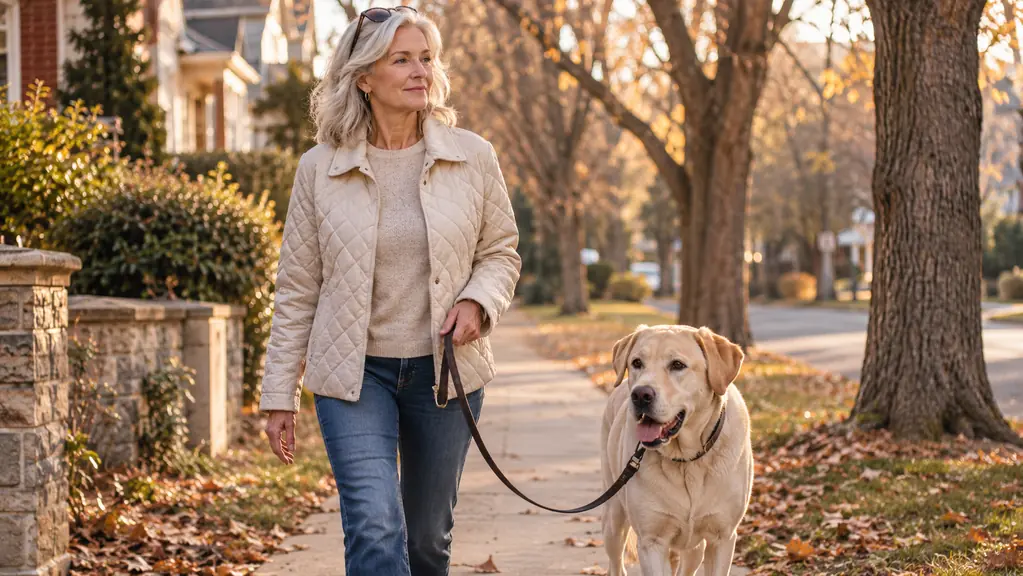
Murphy hit the end of the leash on an icy sidewalk in January and I did not. My feet went out from under me, I landed on my right hip, and every bit of his 72 pounds traveled up a six-foot leash and into my wrist. Nothing broke except my confidence. Two weeks later a rabbitgoo no-pull harness arrived in a box, and I have walked him in it twice a day, about two miles a day, for fourteen months since. I still own a flat nylon collar. It lives on him for his tags. That is the whole comparison, and I have opinions about which piece of gear does the actual work.
Short answer first. For a strong dog who is convinced every squirrel owes him money, the rabbitgoo harness is easier on my hands, my shoulder and my balance, and it is not particularly close. The collar wins exactly two rounds, and they are real rounds: heat and speed. If your dog already walks politely on a slack leash, keep the collar and spend your money elsewhere.
| rabbitgoo No-Pull Harness | Standard Flat Collar | |
|---|---|---|
| Leash attachment points | Two sturdy metal hook loops, one at the chest and one on the back | One D-ring at the back of the neck |
| Where the pressure lands | Spread across the chest and shoulders on padded vest panels | Straight across the front of the throat |
| Steering a dog who leans | The chest loop turns his shoulders back toward me | Pulls straight back and he leans harder into it |
| Adjustability | Four adjustable straps, chest fit 17 to 33.4 inches on the large | One buckle and sometimes a sliding keeper |
| A dog who backs up | Sits over the body and is much harder to wriggle out of | A loose collar can slide straight over the ears |
| Low-light visibility | Reflective strips on the panels | Usually nothing reflective at all |
| Heat on a July walk | Breathable mesh, but there is still fabric across the chest | Almost nothing on the dog |
| Time to put on | Buckle it, then check four straps | Slips over the head in a second |
| Holding the ID tags | The collar stays on underneath, so this is a second layer | One piece of gear for tags and for walking |
| A dog who already walks on a slack leash | Works fine, but you are buying control you do not need | Perfectly adequate |
How I Ended Up Comparing a Harness to a Collar
Murphy came home from the county shelter at two years old wearing a flat nylon collar and carrying no instructions. For four years that collar was the entire system. I clipped a six-foot leash to the D-ring, wrapped the handle around my wrist the way my mother did with every dog she ever owned, and let him tow me down the block. He is a yellow Labrador mix, about 72 pounds, and he has never once considered the possibility that the squirrel might win.
Then came the ice. January, six in the morning, the sidewalk at the end of the street still slick where the houses shade it. He saw the squirrel, hit the end of the leash, and down I went. Dale says I made a sound like a dropped hymnal. My wrist ached for a month. What bothered me longer was the arithmetic. I am 61, my right shoulder has spent a career lifting book crates and, lately, holding quilt sandwiches steady under a machine needle, and I had just handed a 72-pound animal a handle on it.
The first harness walk was a mess, and not because of the harness. I had the straps too loose, the leash clipped to the back loop, and no idea what I was doing. Murphy walked like a dog wearing a raincoat for the first time. It took about a week of fiddling before the thing started working the way it is supposed to.
Where the rabbitgoo Harness Wins
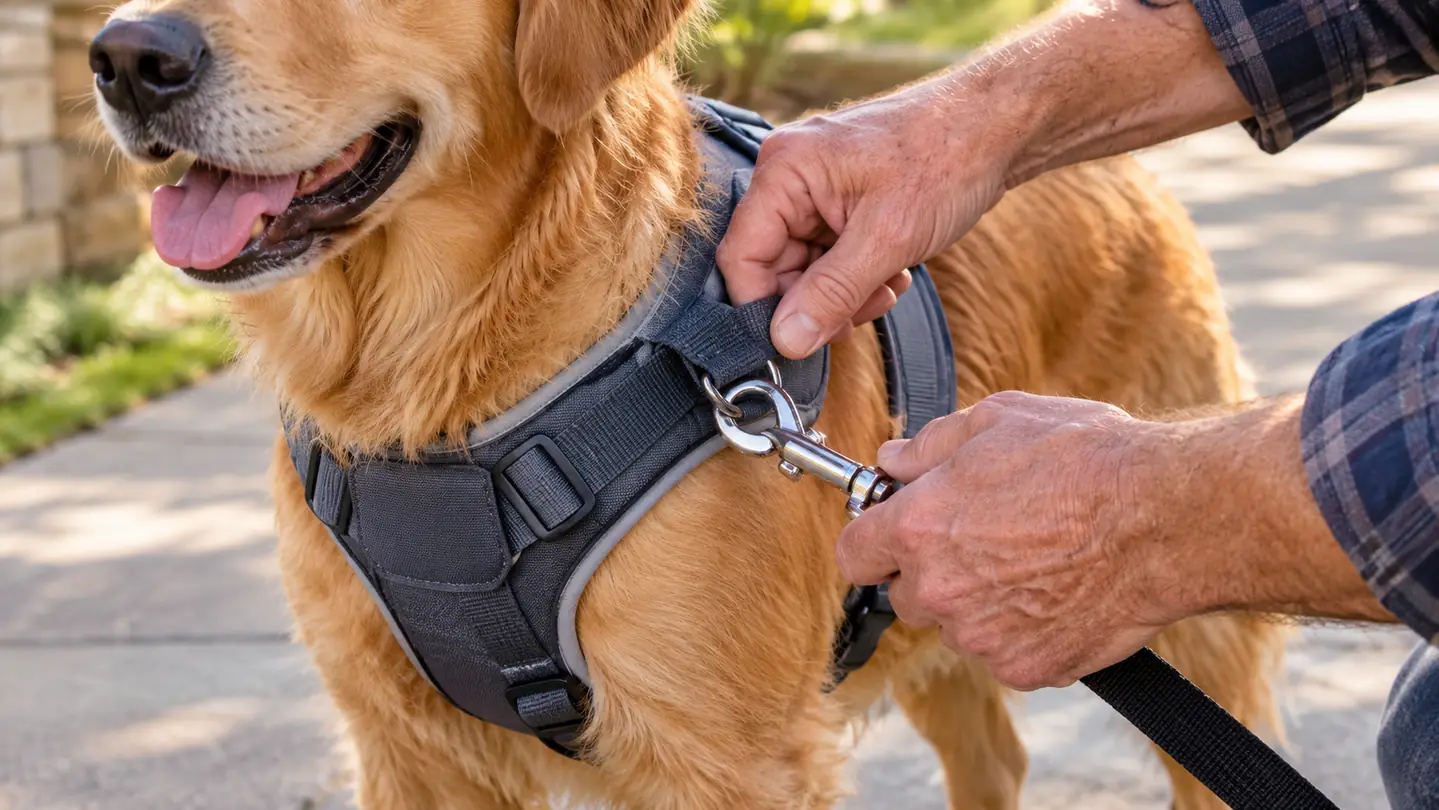
The chest loop is the whole trick. When Murphy leans into the leash now, the clip at his chest pulls him sideways rather than backward, so his own momentum turns him toward me. He does not get choked into stopping. He gets redirected, which is a different thing and a better one. There is a second metal loop on the back for the calm stretches, and the difference between the two attachment points is the difference between a steering wheel and a tow rope.
The second win is where the pressure lands. A collar puts all of it on the front of the throat. This vest spreads it across the chest and shoulders on polyester panels with breathable mesh, and the four adjustable straps mean the fit is not a guess. The large is cut for a chest of 17 to 33.4 inches. On Murphy I set it so I can slide two fingers under every strap and no more. It has never come off over his head, and he has tried, usually when a delivery truck rolls past.
The third win is one I did not expect to care about. The reflective strips on the panels are actual reflective material, not a decorative stripe. In December I walk him at half past six in the morning, in the dark, on a street with no sidewalks in places. Headlights pick him up from a long way off. That is worth more to me than any other feature on the list, and it is the one nobody mentions when they talk about pulling.
Where the Standard Collar Wins
Heat, speed, and the fact that the collar is not going anywhere. Knoxville in August is a wet wool blanket, and any fabric across a dog's chest makes him warmer than a strap around his neck does. On the worst afternoons we walk at dusk with the leash on the back loop and I let him set a slower pace. The collar also goes on in one second. There is no second piece of gear to keep track of by the door, and the tags live on it, which means the harness goes on top of the collar rather than instead of it.
And I will say the unpopular thing. A harness is not automatically better. A dog who already walks on a slack leash does not need one. My neighbor's old retriever shuffles along like a man on his way to a nap, and a plain collar is completely adequate for him. Gear cannot teach a loose leash by itself. It can only stop a strong dog from hurting you while you teach it, and if your dog does not need the help, the harness is just extra laundry.
The harness I reach for when Murphy is already leaning
Fourteen months, about 850 miles, one harness, and every seam is still closed. Two leash loops, four adjustable straps, reflective strips, and a chest fit of 17 to 33.4 inches on the large. Today's price is on the listing.
Amazon Check Today's Price on Amazon →Fourteen months, about 850 miles, one harness, faded but intact, and every seam still closed.
What Fourteen Months Did to the Stitching
I quilt, which means I cannot look at a seam without judging it, and I have unpicked enough of my own work to know what a stressed stitch looks like. So here is the report. The webbing on the four adjustment straps has faded and the edges have gone soft where my fingers work them every morning, but there is no fraying at the buckle ends and no pulled threads where the straps meet the body of the vest. The mesh panels have kept their shape. The reflective strips have not peeled or cracked, which is more than I can say for a reflective band I sewed onto a jacket two winters ago.
The buckles still click the way they did in the first week. The stitching along the chest panel is a double row, straight, with no skipped stitches and no loose tails, and the thread has not gone fuzzy at the contact points. If I had sewn it myself I would have backstitched the strap anchors more heavily. They have held anyway, through fourteen months of twice-daily walks and one dog who remains certain that commitment is all he has been missing.
It looks its age. It has been rained on, snowed on, dragged through mud at the lake trail, and washed by hand maybe half a dozen times. Faded but intact is the honest description. I have not replaced a single part, and the listing carries a warranty for quality issues, which I have not had to use.
The Part Nobody Mentions: Your Shoulder, Not the Dog's Neck
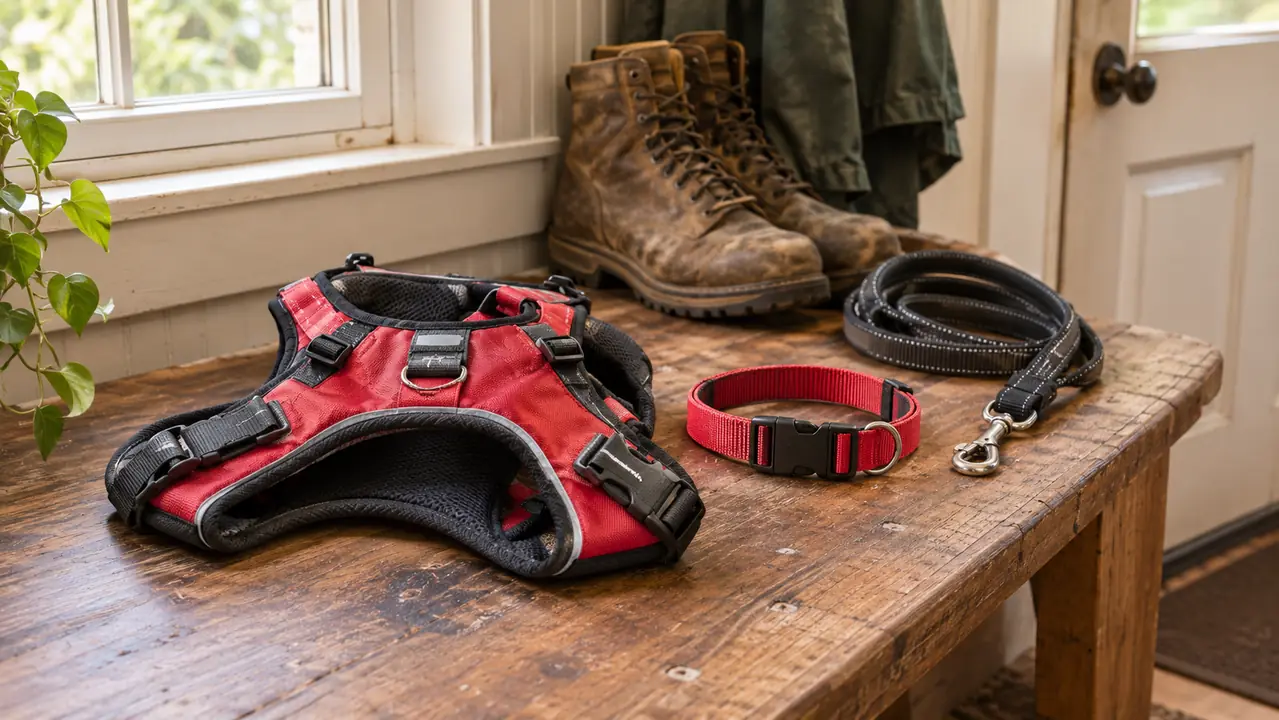
Most harness talk is about the dog, which is fair, since it is his harness. But the reason I keep using it is on my side of the leash. Before, a pull went straight into my wrist and up into my shoulder, and I spent the rest of the walk braced for the next one. Bracing is exhausting in a way that walking is not. My hands are not what they were at 40, and holding a taut line against 72 pounds of committed Labrador is a grip exercise I did not sign up for.
Now the leash is slack for most of the walk. When it is not, the harness turns him and the load spreads across his chest instead of hanging off the end of my arm. I get home with my shoulder where I left it. That does not sound like much until you have spent a whole winter walking a dog who pulls, and then it sounds like the only feature that matters.
The One Adjustment That Changed the Walk
For the first month I used the back loop and wondered what everyone was on about. The back loop is a leash attachment, not a steering aid. The change came when I moved the clip to the chest loop, shortened the leash to about four feet, and stopped letting him build speed before I corrected anything. A pull that never reaches full length is a much smaller problem than a pull at the end of six feet.
The other change was the fit. Four straps is two more than most harnesses have, and it takes a few walks to get them right. Start with the chest strap, then the two shoulder straps, then the belly strap, and check each one with two fingers underneath. Too loose and he can wriggle, too tight and you will see it in how he moves. Once mine were set I have not touched them since, and I do not expect to.
What I Would Change
Two complaints, both small. Putting it on takes longer than a collar, and in the first week I was late for a vet appointment because I was hunched over in the driveway fussing with a strap. And it is warmer for him than a collar, which is the trade for the padding and the mesh. On a hot day I notice it and he notices it.
Neither complaint is enough to send me back to walking him on a collar. But if you are the kind of person who wants one piece of gear, no adjustments, and nothing to think about, this is a piece of equipment that asks a little from you in exchange for what it does.
Who Should Buy Which
Buy the rabbitgoo harness if your dog is strong, if he pulls, if he backs out of a collar when he is startled, or if you have ever felt a shoulder or a wrist complain three blocks from home. Buy it if you walk before sunrise or after dark, because the reflective strips are real. Get the large if the chest measures in the 17 to 33.4 inch range, and measure with a soft tape around the widest part of the ribs behind the front legs, not around the neck, because a neck measurement will send you to the wrong size every time.
Stay with a plain collar if your dog already walks politely, if you live somewhere hot and walk at midday, or if you want one simple piece of gear. That is not a consolation prize. A calm dog on a flat collar is a perfectly good walk, and a harness will not make it better. What a harness does is buy you control while you teach the loose leash, and it does that job with less damage to the human on the other end.
Either way, keep the collar on for the tags. This was never a competition for the dog's neck. It is a question of what goes on the leash, and for a dog like mine the answer is a harness with a front clip and four straps I set once and forgot.
If your shoulder already knows what I mean, start here
The collar can stay on for the tags. Put the rabbitgoo harness on for the walk. Two leash loops, four adjustable straps, breathable mesh, and reflective strips for the dark half of the year.
Amazon See the rabbitgoo No-Pull Harness on Amazon →