
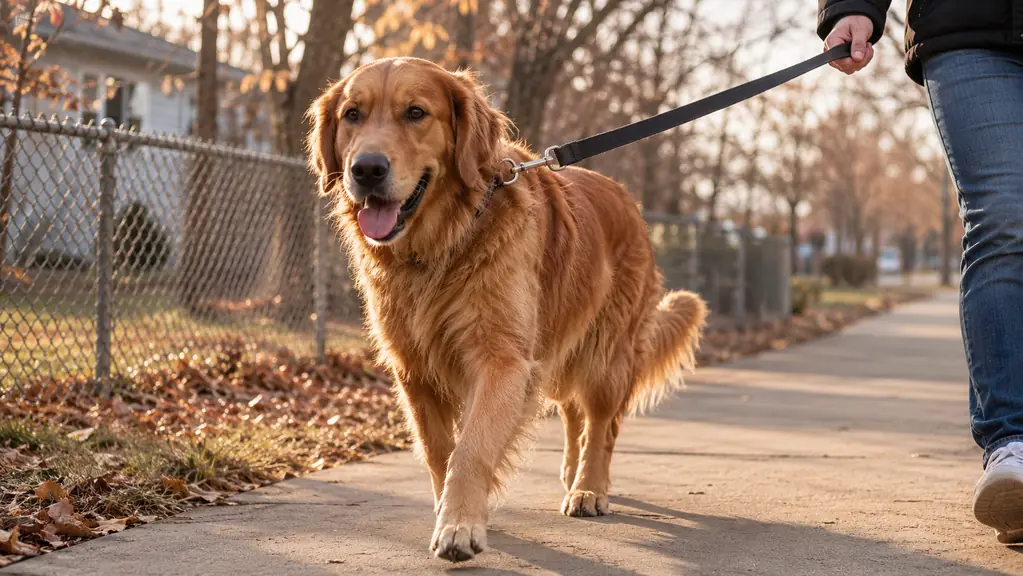
The ice did most of the work. Murphy spotted a squirrel, hit the end of his collar at a dead run, and I went down on one knee on the sidewalk just past the Hendersons' mailbox. He is a yellow Labrador mix, seventy-two pounds, six years old, and not a bit sorry. What bothered me afterward was not the fall. It was that I had walked that same route twice a day for two years and never once asked what a flat nylon collar was doing to a dog stronger than the person holding the leash.
Two weeks later I ordered the rabbitgoo No-Pull Dog Harness in a size Large. I picked it because the listing promised two leash clips and I wanted the option of steering from the chest instead of from the shoulders. That was fourteen months ago. Since then Murphy and I have done the same two miles a day, split between a morning walk and an afternoon one, through Tennessee heat and through the wet cold that gets into your knees. It is the same harness. It has faded. The mesh feels softer than it did. Nothing has torn, no strap has crept out of adjustment, and no buckle has popped open on a lunging dog. This is the long version of that report.
The Quick Verdict
It steers a seventy-two pound dog without the gagging, and the stitching has held for fourteen months. It does not teach him anything, and the sizing will not forgive a guess. Still the best thing hanging on my leash hook.
Amazon Check Today's Price →Front clip for the squirrel days. Rear clip for the calm ones.
Fourteen months and roughly 850 miles on one harness, and the original buckles still snap shut with a solid click. Today's price and the size chart are on the listing.
Amazon Check Today's Price on Amazon →How I've Used It
The routine is dull, which is the point. Out the back door a little before seven, up the hill to the stop sign, left along the chain-link at the elementary school, then home for breakfast. Repeat around four in the afternoon. About two miles a day in total, more when Dale comes along and we take the long way past the duck pond. Murphy has opinions about the duck pond.
Before the harness I walked him on a flat nylon collar, the kind that comes home with any dog from any shelter. Murphy is not a difficult dog. He is a hopeful one, and hope in a Labrador mix looks like a sudden forty-yard sprint toward something with a tail. On a collar, every one of those cost him a gag. He would cough for a few steps, shake it off, and do it again at the next mailbox. For two years I told myself he was getting better. He was not getting better. I was getting better at bracing.
The chest clip changed the geometry of the whole walk. When he surges now, the leash pulls across his chest instead of against his throat, so his front end swings toward me rather than away. He cannot get his weight behind it the way he could on a collar. He still leans, and on a really good squirrel he still gets a step or two, but he is not choking himself and I am not being towed. That is the entire reason I bought it and the entire reason I still reach for it.
There was a morning in February that made the case better than anything I could write in a summary. We were coming down the hill toward the stop sign when a garbage truck came around the corner, and Murphy decided that truck was the most important thing that had ever happened to him. On a collar that would have been a full-body pull into his windpipe and my right shoulder. With the chest clip he went sideways into the grass strip and stalled there, front feet braced, and I simply stood still until the truck passed. Ten seconds, maybe twelve. Nobody got dragged and he did not cough once. I remember it because it was the first morning I did not brace before he lunged.
The Two Clips, and Which One I Reach For
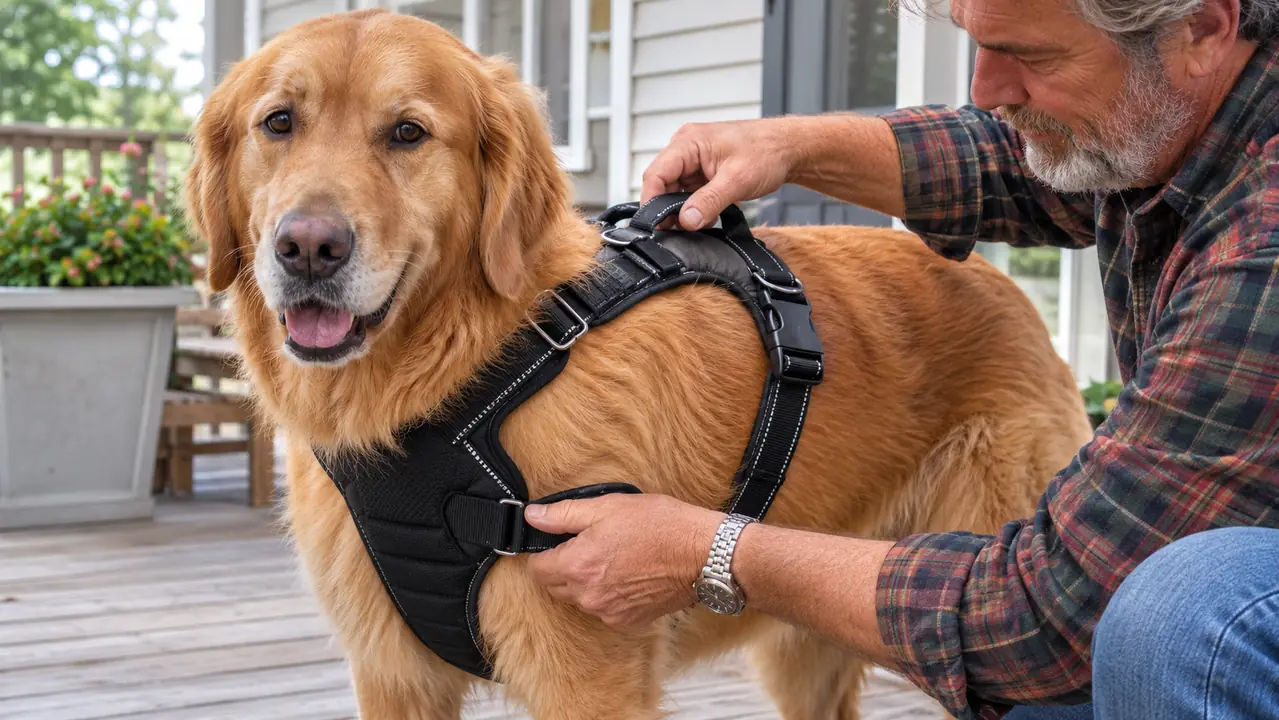
The rabbitgoo harness has two metal hook loops for the leash, one at the chest and one set further back. Fourteen months in, both still sit flat and neither has worn shiny at the bend, which is what I expected to see first. I use the chest loop on nearly every neighborhood walk. It is the setting that turns a lunge into a curve.
I switch to the rear loop out at the lake trail, where I want Murphy to have his full range and where there is nothing to lunge at except water. On the rear loop he can absolutely still pull, and he knows it. That is not a flaw in the harness. A rear clip is a comfort setting, not a steering setting, and it took me about a week to stop expecting otherwise.
What I did not appreciate until winter is that having both means I never had to buy a second piece of gear when the walk changed. The morning loop around the block and the Saturday trail walk use the same harness, just a different loop. For a household with one dog and limited hooks by the door, that is worth more than it sounds.
I check the hardware about once a month, the way I check a seam before I bind a quilt. Both loops are metal, both sit flush against the vest, and both attach through a doubled strip of webbing rather than a single layer. That doubled strip is the detail I would look for on any harness now, because a single layer of webbing around a metal loop is where a cheap harness wears through first. After fourteen months of daily use I cannot find a frayed edge at either attachment point. The rabbitgoo harness still looks like it will outlast the leash.
Fourteen Months Through a Quilter's Eye
I spend most evenings at a sewing machine, and that has ruined me for soft goods. I know what a skipped stitch looks like and I know where cheap gear fails first, which is almost always the edges and the binding, not the middle of the panel. So when the harness arrived I turned it over the way I turn over a quilt back before I pin it.
Here is what fourteen months did. The binding around the edges of the vest has gone soft and slightly fuzzy, but it has not frayed through anywhere. The seams along the webbing, which take the whole load when Murphy hits the end, have held. The stitching is still tight enough that I cannot work a fingernail under it. That is the test I actually trust, more than any tugging on a strap in the kitchen.
The polyester has faded, mostly across the top where the sun lands. The mesh has pilled a touch where the straps rub against it. Neither is a failure. The fading is the only thing I can point to and say, honestly, that the harness no longer looks new.
The buckles are what I expected to go. Plastic closures on dog gear usually develop a hesitation before they release, or a rattle in the housing. These still snap shut with a solid click. They have never come open on a lunge, including the morning a loose retriever came around the corner and Murphy decided he was going to meet it. Reflective strips run down the harness too, and in December, when our morning walk happens in the dark, I am glad of them.
Twice I have hosed it off in the backyard after a muddy March walk and hung it over the porch rail to dry. Once I ran it through the machine on cold inside a mesh laundry bag, which I would not do often but which did it no visible harm. The straps came out of the wash still sitting where I had set them, which surprised me more than anything else in this review. What I watch on anything soft is the point where fabric meets hardware, because that is where a seam begins to give. Fourteen months in, the fabric around both metal loops is intact and the binding has not opened at a single corner. The rabbitgoo harness has outlasted two pairs of Dale's work gloves and one pair of my own garden clogs in the same stretch of time.
Getting the Fit Right on a Strong Dog
Four adjustable straps hold this thing on a dog, and every one of them earns its place. Sizing runs on chest measurement. The Large is listed at 17 to 33.4 inches at the chest with a weight range of 15 to 45 kilograms. Murphy measured 31 inches around and weighs about 33 kilograms, which puts him at the upper middle of the size. If he were much deeper in the chest I would be looking at the next size up rather than squeezing him into this one, and I would not argue with anyone who sized up anyway.
I fit it the way I fit a quilt binding, which is to say slowly and twice. Two fingers should slide under each strap and no more. Any looser and the chest panel drifts sideways on a pull, which is how you get a rub mark under the front leg. Any tighter and you have built a corset.
Then I rechecked after a week, because new webbing settles. After fourteen months I still run a hand under the chest strap before we leave the driveway. It has not needed adjusting since that first week, but the habit costs four seconds and I have been saved by it before, back when I was fitting a collar instead.
The first fitting happened on a Saturday, with Dale holding a biscuit at Murphy's nose and me on the kitchen floor with a cloth tape. Chest came to 31 inches. I wanted the vest sitting behind his shoulder blades rather than up on his withers, so I set all four straps, walked him once around the block, came back in, and moved two of them a single hole each. A week later I took the chest strap in one more hole as the webbing relaxed. Per the rabbitgoo size chart the Large covers 17 to 33.4 inches at the chest, so he is not close to the top of it, and I would tell anyone measuring past 32 to measure twice and think hard about the next size up.
What It Does Not Fix
A harness is not a training program, and I want to be clear about that because the product photos make it look like a cure. Fourteen months in, Murphy still pulls toward squirrels. He pulls less successfully. The harness redirects him. It has not taught him manners, and I suspect if I walked him on a collar for a month we would be right back where we started, with me bracing on the hill.
There is one small annoyance I have not solved. On a hard lunge, the leash running from the front clip can drop under his chest and catch behind a front leg for a second before it frees itself. It has never hurt him and it has never tripped either of us, but I notice it. I noticed it far more in the first month than I do now that I keep a shorter loop of leash gathered in my hand.
And during the spring shed, the mesh holds hair the way a fleece jacket holds hair. I knock it off against the porch rail about once a week. That is not a defect in the harness. That is a Labrador.
What I Liked
- Steers a seventy-two pound dog from the chest with no pressure on his throat
- Two metal leash loops, so one harness covers both the working walk and the easy one
- Four adjustable straps, and the fit has not crept in fourteen months
- Seams, binding and buckles have all survived roughly 850 miles of daily use
- Reflective strips for the dark half of the year
Where It Falls Short
- It redirects a puller, it does not train one
- The mesh collects shed hair and needs regular knocking off
- Sizing is unforgiving, so measure the chest rather than guessing by breed
- The front leash can slip behind a front leg during a hard lunge
- The fabric fades in the sun, which looks worse than it is
Roughly 850 miles, two leash loops, four straps, and the original buckles still snap shut with a solid click.
Who This Is For
This is for the owner of a strong, hopeful dog who has already figured out that a collar is a negotiation the dog wins. If your shoulder aches after a walk, if your dog coughs when he hits the end of the leash, if you have started choosing routes by which one has fewer squirrels, the chest clip alone will change your mornings. It suits a big dog in the 15 to 45 kilogram range and it suits an owner who wants one piece of gear that works instead of a drawer full of things that almost did. It also suits anyone who walks in the dark half of the year, because the reflective strips are not decoration. I am sixty-one and I walk a seventy-two pound dog by myself. That is the honest endorsement.
Who Should Skip It
Skip it if you want the harness to do the training, because it will not. Skip it if your dog sits between sizes and you are hoping to fudge the fit, because chest measurement is the whole fit and a loose harness on a hard puller will rub. Skip it if you need a containment system rather than a walking vest, since this closes with buckles and is not built to hold a determined escape artist. And skip it if you plan to layer it under a winter coat on bitter mornings. I put Murphy's coat on over the harness on the coldest days and it works fine, but it costs an extra minute I do not always have at seven in the morning.
Fourteen months on one harness, and I have stopped shopping.
Measure the chest, start on the front loop, and give it a week before you decide. Current price and the size chart are on the listing.
Amazon Check Today's Price on Amazon →