
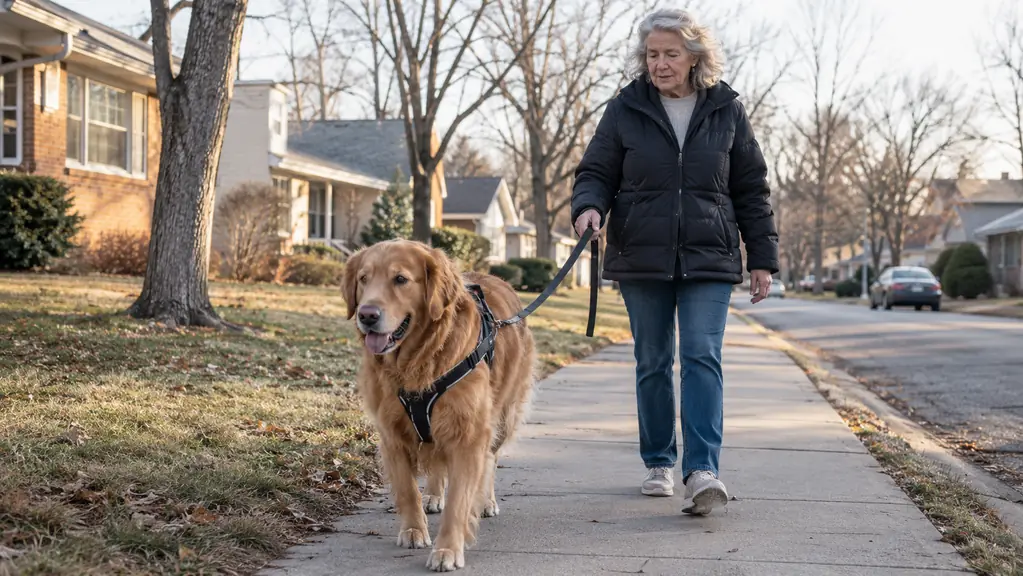
The first time Murphy pulled me off balance, the sidewalk had a thin skin of ice and I was carrying a bag of library returns I had no business carrying. He saw a squirrel, I saw the ground come up, and we both learned something about who was steering. I am 61, retired from the school library, and not built to be a sled dog anchor.
Murphy is 6, a yellow Labrador mix, about 72 pounds, adopted from the county shelter when he was 2. He is strong in the shoulders and optimistic about squirrels. On a flat nylon collar, our twice-daily neighborhood walks had turned into a negotiation. He would lean into the collar, cough, and keep leaning. My right shoulder would ache by the time we got back to the porch.
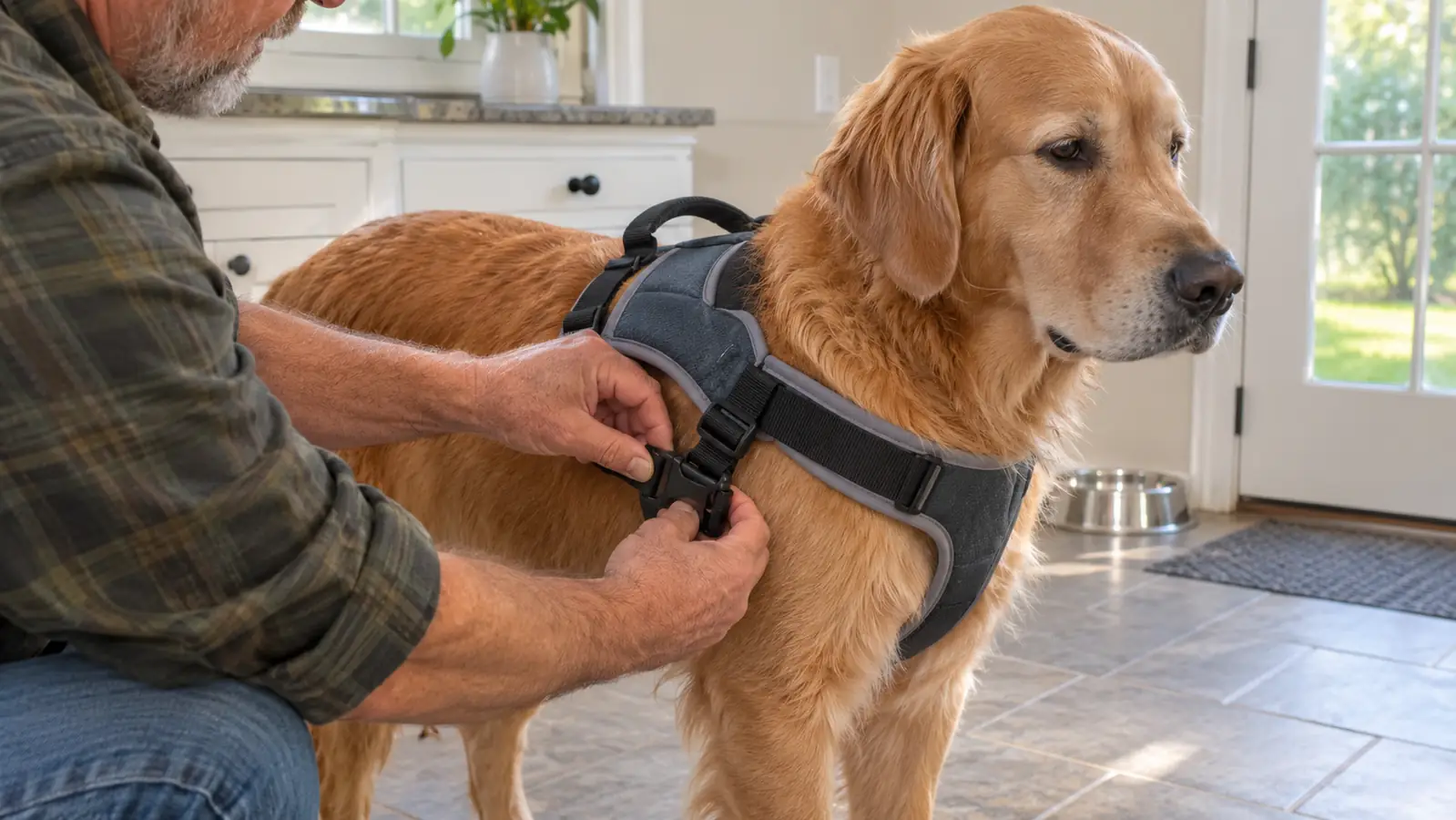
I did what I usually do when a problem gets sharp enough. I ordered the rabbitgoo No-Pull Harness in size Large about 14 months ago, after a morning when Murphy pulled me sideways and I caught myself on a mailbox. The harness arrived with instructions, a buckle closure, and four adjustable straps. It is made of polyester fabric with breathable mesh, and it has two metal hook loops for the leash. That is the plain description. What mattered was whether it would change the walk.
I fitted it in the kitchen with Murphy standing on the tile and Dale reading the instructions over my shoulder. Chest measurement matters here, and the large is listed for a chest of 17 to 33.4 inches and a weight range of 15 to 45 kilograms. Murphy is 72 pounds, so he sits well inside that range. The first fit took me a few minutes because the straps have to be balanced, not just tightened. I put it on, checked that I could slide two fingers under each strap, and we went out.
I noticed the seams because I quilt. I spend winter evenings at the machine, and I have opinions about stitching on anything soft. The fabric is polyester, the mesh is breathable, and the seams at the strap anchors have held through 14 months of use. The buckle is a solid piece, not a thin tab. That is not a laboratory finding. It is what I check before I trust a piece of gear with a dog who lunges.
Fourteen months of twice-daily walks, about two miles a day, using the chest loop. The harness is faded now, from sun and from being hung on the porch rail, but it is intact. The straps still hold where I set them. The reflective strips still catch headlights on the early walk, which matters because we go before the school bus and the road is dark in winter.
Fourteen months later, the original harness is faded but intact, and I still use it twice a day.
The chest loop gave me back the morning walk
If your dog is stronger than your shoulder, start with the size chart and measure the chest before you order. The large rabbitgoo harness fits Murphy at 72 pounds, and the second clip gives you options when the squirrel situation changes.
Amazon Check Today's Price on Amazon →What the harness did was not magic. Murphy still wants the squirrel. He still tests the line when a cat crosses the driveway. But the chest loop turns him slightly toward me when he surges, so he is not dragging me straight down the sidewalk. The pulling became steering. I could walk him with one hand and keep my shoulder in its socket. On the icy mornings, that is the whole game.
The fit is adjustable in four places, which is more useful than it sounds. A dog's shape changes with age. Murphy has stiffened a little after long walks, and I do not want a harness that rubs under the front legs. I can loosen the chest straps a touch on a sore day and still keep the harness from sliding. I check the straps every week, the same way I check a quilt binding, because small slips turn into big rubs.
There is a learning curve. The first few walks, I fussed with the straps and made us both stand still while I adjusted. The buckle takes a firm press to open, which I like now and did not like on the first cold morning. The harness is more gear than a collar. It takes a minute to put on, and if your dog dances when he sees the leash, that minute can feel longer.
The reflective strips are a real feature, not decoration. Our early walk is before sunrise in January, and the strips on the chest and sides catch car lights. The mesh keeps the fabric from feeling heavy on a warm September day. I would not call it cooling. I would call it less stifling than a bulky padded harness.
Who it suits: a strong dog in the 15 to 45 kilogram range whose owner is tired of being pulled. The rabbitgoo large size has a chest range that covers a lot of Labs, shepherds and huskies. If your dog is at the top of that range or between sizes, measure the chest and ask the company before you guess. A harness that is too loose will rub. One that is too tight will pinch. The four straps are only helpful if you use them.
What I would not do is clip the leash to the collar and expect the same result. The harness is doing a different job. It spreads the pressure across the chest instead of the throat. That is why Murphy stopped coughing on the first walk. The change was not dramatic. It was quiet. He pulled, the harness turned him, and he came back to me instead of fighting the collar.
What I'd Tell You If We Were Sitting at My Kitchen Table
I would tell you to measure the chest twice, because the size chart is the whole purchase. I would tell you that the rabbitgoo harness will not train your dog to ignore squirrels, and it will not make a two-mile walk effortless. What it will do is give you a handle on a strong dog without choking him. I would tell you to check the straps before every walk and to rinse the mud off before it dries in the mesh. And I would tell you that after 14 months, I have not gone back to the collar. That is the recommendation, plain as I can make it.
The walk is still a walk, not a tug of war
Murphy and I still go out twice a day. The harness is faded, the reflective strips still work, and my shoulder is grateful. If you are tired of being the anchor, start with the chest measurement and the large rabbitgoo.
Amazon Check Today's Price on Amazon →