

I bought the Bedsure orthopedic dog bed about ten months ago, on a Tuesday afternoon, because Murphy had started taking a long time to get up off the living room floor. He is six years old, a yellow Labrador mix, about seventy-two pounds, and he came home from the county shelter when he was two. For four years he slept on a flat pillow-style bed from a big box store. By last spring that bed had packed down to about an inch of dead foam, and when he stood up in the morning his back legs came under him slow and stiff.
I do not buy dog beds lightly. Dale will tell you I research a kitchen gadget for a week before I commit. But I also sew quilts in the evenings, and that has ruined me for soft goods. I look at seam allowance. I look at stitch length. I look at whether a zipper is set behind a proper flap or just sewn on top of the fabric and left to chew its way out. The old bed had the stitching of something built to reach a shelf, not to survive a dog. So I read a few hundred reviews, ordered the Bedsure bed in the large size, and put it in the corner by the window where the afternoon light lands. Ten months and roughly twenty wash cycles later, here is the honest account.
The Quick Verdict
A rectangular bolster bed that has held its shape through ten months of a seventy-two pound dog and a wash every two weeks. The cover is the best thing about it. The foam is very good without being bottomless.
Amazon Check Today's Price →Ten months in, this is still the corner Murphy walks to every night
The large size measures 35 by 25 by 7 inches and weighs 5.34 pounds. The cover unzips, washes on cold, and goes back on without a fight. Current price and size options are on the listing.
Amazon Check Today's Price on Amazon →How I've Used It
The bed sits in the living room corner, under the window, on a hardwood floor. It measures 35 by 25 inches across and 7 inches tall at the bolsters, and it weighs 5.34 pounds, light enough that I slide it out of the way when I vacuum and heavy enough that Murphy can dig at it without the whole thing skating across the floor. He is a digger. Every bed we have owned has taken two or three minutes of furious pawing before he will lie down, and this one has not torn at the corners.
Our routine is simple. He sleeps on it at night, from about nine until Dale gets up at six, and he uses it most of the afternoon. It is where he goes when the mail truck comes and where he goes when he wants to be left alone. The rest of the time it is the spot he chooses to watch me work in the kitchen, chin propped on the front bolster, sighing at intervals like a small disappointed foreman.
He took to it in an afternoon, which surprised me. New beds usually sit in the corner for a week while he circles them and walks away. This one he stepped onto, pawed twice, and settled into the back corner with his chin on the bolster. I think the raised sides make it feel like something rather than somewhere, and for a dog that has spent his life on flat mats, that seems to matter.
Cleaning is the part I did not expect to care about. With a Labrador in east Tennessee, the bed collects hair the way a porch collects leaves. The cover comes off with a full perimeter zipper, goes into the machine on cold, and comes out of the dryer on low without shrinking enough to notice. I wash it roughly every two weeks, more often during the spring shed, and it has gone back on the foam every single time without a fifteen minute wrestling match. That alone puts it ahead of most of the soft goods in this house.
The Four-Sided Bolster Is the Feature That Matters
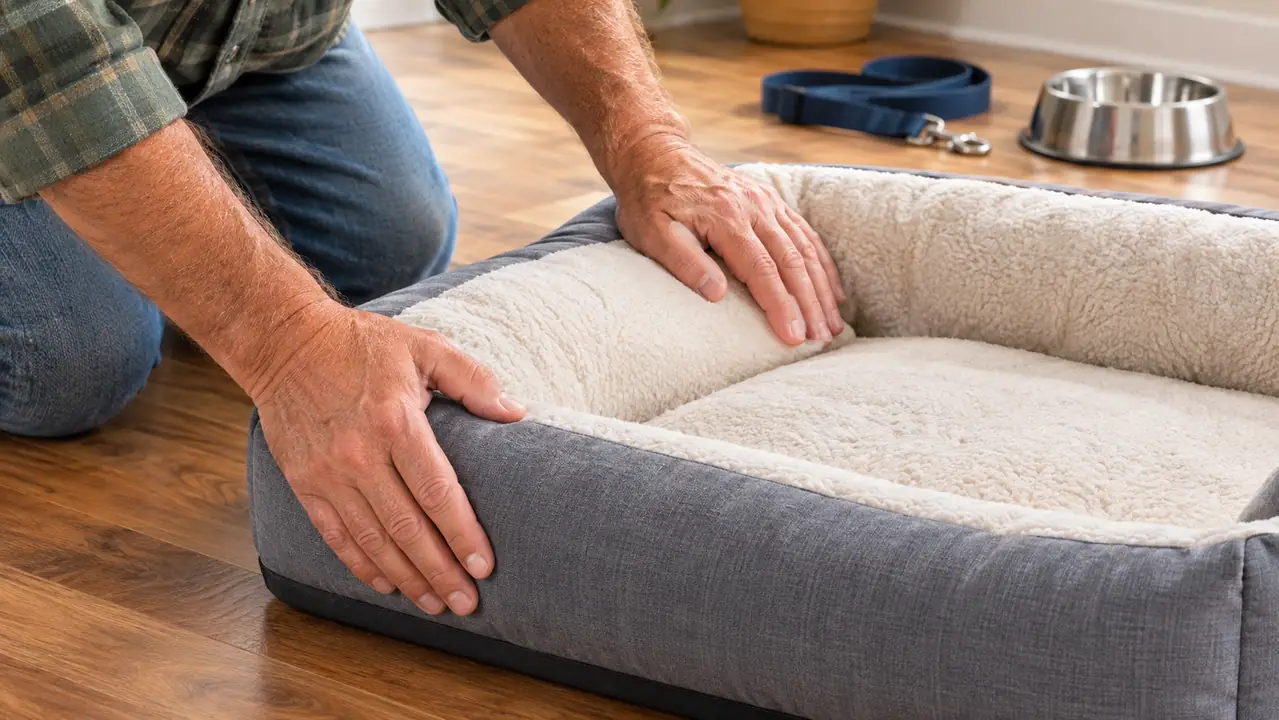
Bedsure builds this as a sofa shape rather than a flat mat: a rectangular base with a bolster running around all four sides. The listing calls it a 4-sided bolster design, and having lived with it, I think that is the whole point of the bed. A flat mat gives a dog somewhere to lie. A bolster gives him something to lean on, and a dog with stiff hips wants to lean.
Murphy uses the bolsters constantly. He rests his chin on the front edge when he is watching the door. He backs into the corner and presses his spine against the back bolster when the house is cold. When he first lies down he circles twice and drops, and the raised sides keep him from sliding off, which was a real problem with the flat bed on a smooth floor.
The bolsters are filled rather than sewn shut as decorative piping, and they have held their loft well. I will be honest that the front bolster, the one that takes his chin and his front paws every day, has softened more than the others. It is not flat. It is softer, the way a good pillow gets softer, and he does not seem to mind. If you want bolsters that stay rigid for years, this is not that product, and I am not certain a bed with rigid bolsters would be comfortable anyway.
Seams, Zipper, and a Quilter's Verdict
Here is where I get picky. The cover is a brushed, low pile fabric with solid panel construction, and the seams are stitched evenly with no puckering at the corners. Corners are where cheap bedding falls apart, because that is where the fabric has to be eased in, and easing takes time on a sewing floor. These corners are clean. Ten months and twenty washes in, I have one small spot of fraying at the inside edge of the zipper tape, and that is the entire list of damage.
The zipper is the other test. It is set behind a fabric flap, which keeps the metal off the dog's skin and keeps hair out of the teeth. It has not caught once. I have owned dog beds where the zipper failed in the second month, and once a zipper goes, the cover is trash and so is the bed.
The materials are certified, which matters more to me than it used to. The bed carries STANDARD 100 by OEKO-TEX certification, number 24.HCN.46956, and the foam inside is CertiPUR-US certified. In plain terms, the fabric has been tested against a list of substances you would not want resting against a dog's skin, and the foam has been tested for emissions. I am not qualified to audit either program. I am qualified to say that this bed had no chemical smell out of the box, which is more than I can say for a crib mattress I bought in 1989.
The cover is also waterproof, and I tested that by accident in month three. A Labrador with a sensitive stomach and a rainy week will explain the rest. The lining held, the foam underneath stayed dry, and I washed the cover and had it back on the same afternoon.
Ten Months In: What Held Up and What Didn't
The foam has not collapsed. That is the headline. The old bed was gone in a year, and the foam in this one still springs back when I press my palm into the middle. There is a slight dip where Murphy's hips land, maybe a quarter inch, and that is after ten months of a seventy-two pound dog sleeping on it every night. I expect several more years out of the foam before I have to think about a replacement.
What has aged is the cover's surface. The fabric has pilled a little where his front paws push off, which is normal for any brushed fabric, and it has faded slightly in the window light. Neither affects how the bed works. If you care about a bed that looks showroom new two years in, buy something with a tighter weave and accept that it will feel slicker to lie on.
The base has stayed flat on the floor and has not curled at the edges. That sounds like a small thing until you have watched a dog step onto a bed that folds up under his foot and then refuse to use it again. Murphy is particular that way. He will not step onto anything that moves under him.
One more honest note. This is not a veterinary product. It is a foam bed with bolsters, and it did not cure anything. What it did was give a stiff dog a softer landing when he lies down and a raised edge to push against when he gets up, and I noticed the difference in how he moved in the mornings within about three weeks. Your results will depend on your dog and on what is actually wrong with his hips.

About That Weight Number on the Listing
The Bedsure listing gives a maximum weight recommendation of 30 pounds. I want to address that, because it confused me before I ordered and it may confuse you. Thirty pounds is well under Murphy's seventy-two, and this is sold as a large bed at 35 by 25 inches. What I can tell you is what I observed: a seventy-two pound Labrador has slept on it nightly for ten months, and the foam under his hips has not bottomed out. The bolsters have compressed, the cover has pilled, and the platform is still a platform.
Where I would take that number seriously is with a dog much heavier than Murphy, or a dog who likes to stand on the bolsters instead of lying inside them. Feet concentrate weight in a way a body does not, and a ninety pound dog who treats the rim as a step will wear it out faster. If your dog is over eighty pounds and restless, size up or look for a bed with a thicker foam base.
What I Liked
- Cover unzips and washes clean, twenty cycles in and the zipper still runs
- Foam has not collapsed under a seventy-two pound dog after ten months
- Bolsters on all four sides give a stiff dog something to push against
- Waterproof lining held through one accident in month three
- No chemical smell out of the box
- Light enough at 5.34 pounds to move for vacuuming
Where It Falls Short
- The 30 pound weight recommendation on the listing reads far too low for the large size
- Front bolster has softened noticeably, which is the one Murphy leans on most
- Cover pills and fades in direct window light
- Not a fix for a dog with a real medical problem
Twenty washes in, the zipper has not caught once, and the foam under his hips has not gone flat. That is most of the review, really.
Who This Is For
This bed is for the owner of a middle-aged dog in the forty to seventy-five pound range who has started to slow down on the stairs or take a beat before standing. It is for someone who wants to wash a dog bed without a fight, which makes the removable cover a requirement rather than a nice extra. And it is for a household where the dog sleeps in one spot every night and the bed is going to be seen, because the sofa shape reads as furniture in a way a flat mat never does.
It is also for the person who sews, or who at least knows what a bad seam looks like. If you have ever turned a dog bed cover inside out and found the corners held with three stitches and a prayer, you will notice the difference here.
Who Should Skip It
Skip it if your dog is over eighty pounds, or if he treats furniture as a challenge. The bolsters are filled soft and they will not survive a determined chewer. Skip it if you want a bed that stays rigid and firm for a decade, because the front bolster softens, and that is by design rather than by defect.
Skip it, too, if you are looking for something to solve a medical problem. A bed is a surface, not a treatment. If your dog is limping or has been diagnosed with hip dysplasia, talk to your vet first and let the bed be one small part of the plan, the same way a decent mattress is one small part of a bad back.
And skip it if you need something that rides in the truck and gets hosed off in the driveway. This is indoor furniture with a washable cover, and it deserves to be treated that way.
Ten months of a Lab and a wash every two weeks. Still his bed.
The large measures 35 by 25 by 7 inches, weighs 5.34 pounds, and the cover comes off in under a minute. Today's price is on the listing, and the size chart is worth a look before you order.
Amazon Check Today's Price on Amazon →