
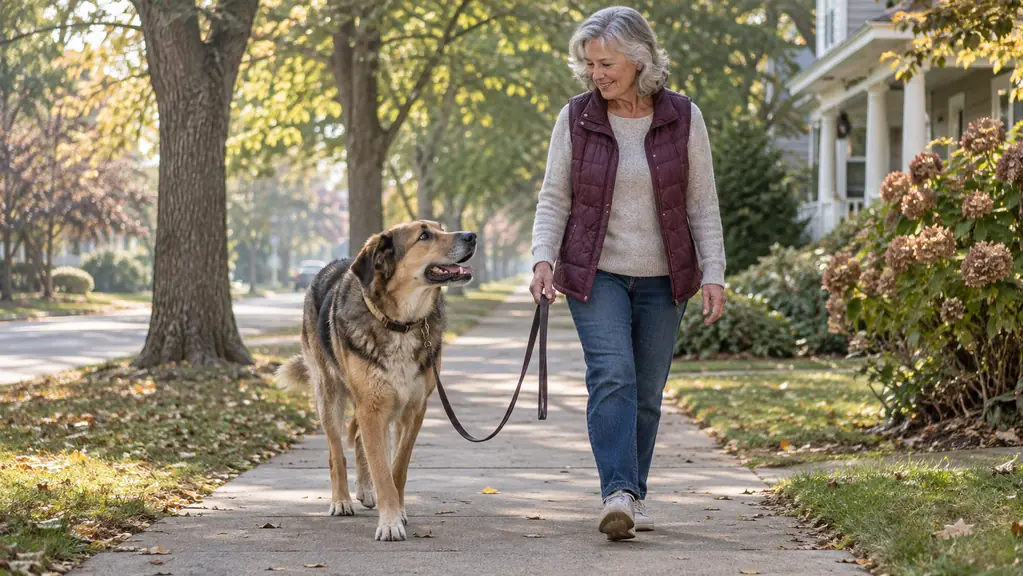
Murphy is a 72-pound yellow Labrador mix with a squirrel radar and no opinion at all about my right shoulder. For four years I walked him on a flat nylon collar, and for four years the first block of every walk was a negotiation I lost. Then one icy morning he bolted after a squirrel, I went sideways on the sidewalk, and I ordered the rabbitgoo no-pull harness that same afternoon. That was fourteen months ago. We do about two miles a day, twice a day, and it is still the same harness, sun faded but in one piece.
This is not a spec sheet. These are the ten things that got easier, roughly in the order I noticed them. Some are about the dog. A couple are about me. One is about stitching, because I quilt in the evenings and I cannot look at a seam without judging it. If you want the long version with measurements and the parts I did not love, my full rabbitgoo harness review covers it.
The harness that ended the shoulder workouts
A front chest clip for the squirrel mornings, a back clip for the slow sniffing loop, and four straps to fit a dog who is not a show dog. This is the one Murphy has worn for fourteen months.
Amazon Check Today's Price on Amazon →You get your arm back
For four years my right shoulder did the work of a sled dog. Murphy leaned into the collar, I leaned back, and by the end of two miles my hand ached and my shoulder had that hot pull in it. The first week in the rabbitgoo harness I kept waiting for the lean. It came, but it came low and across his chest instead of straight down the leash, and my arm stopped doing the heavy lifting. Now the leash hangs in a loose curve for most of the walk, and I can carry a bag in my other hand like a normal person.
The front clip turns a pull into a turn
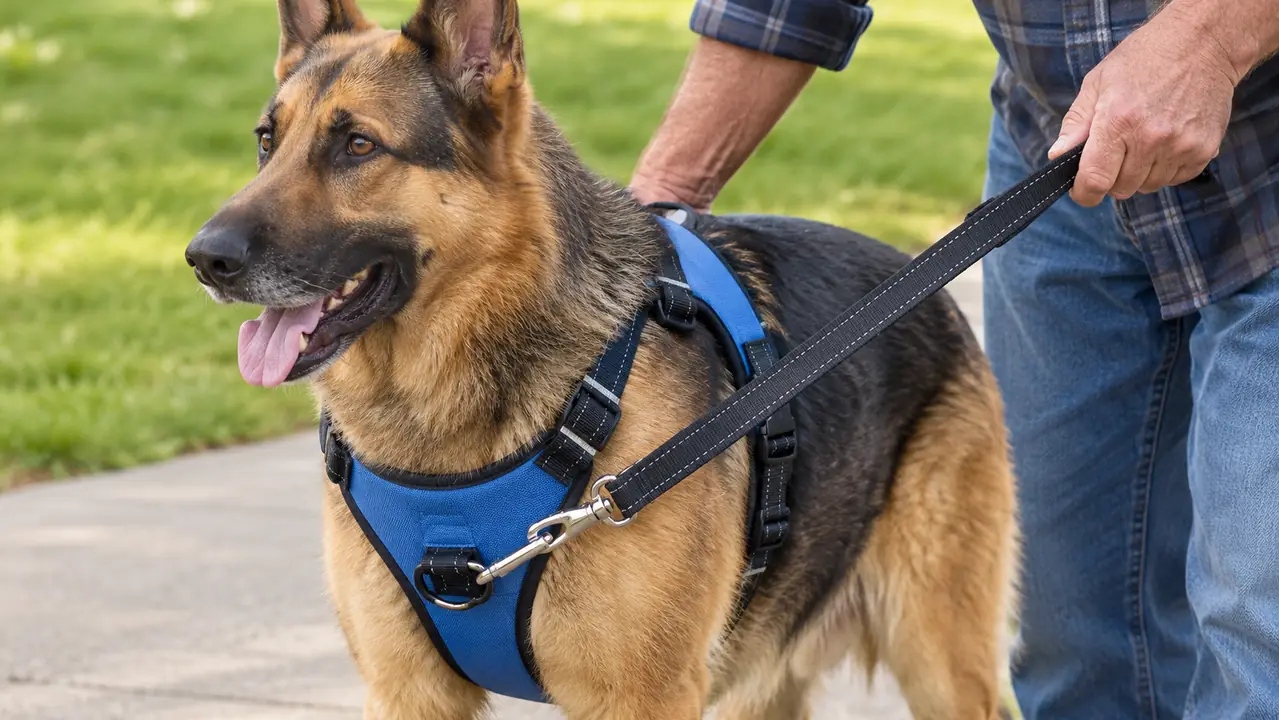
When he surges, the leash pulls across his chest at an angle rather than straight ahead. That sideways pressure swings his front end back toward me, and he has to slow down and re-aim. It is not instant obedience. The first week he fought it and walked like a dog wearing a question mark. The second week he stopped bothering. I use the front loop on about nine walks out of ten, mostly because most of our walks involve a squirrel at some point.
Two leash clips for two different dogs in one dog
There are two metal hook loops on this harness, one on the chest and one on the back. The front one is for squirrel mornings and the first ten minutes when he is fresh. The back one is for the slow loop around the block when I am in no hurry and neither is he. Having both on one harness means I am not swapping gear at the door. I just clip wherever the morning calls for. Fourteen months in, both loops still sit flat and neither has bent.
The pressure lands on his chest, not his windpipe
On the flat collar, a hard stop meant a cough. He would cough twice and look at me like I had done it on purpose. The harness spreads that pressure across his chest and shoulders instead of one narrow band on his throat. On a two mile walk he can pant, drink from the bottle I carry, and bark at the mail truck without sounding like he is being strangled. That alone was worth the switch for me.
Four straps fit a dog who is not a show dog
The large is listed at a 17 to 33.4 inch chest, and Murphy measures 31 at his widest. He is a shelter mix with a deep chest and a waist narrower than his ribs, which is exactly the shape a two-strap harness fits badly. Four adjustable straps let me take in the neck and the chest separately instead of choosing which end to squeeze. It took two walks of fiddling at the kitchen door to get it right. I have barely touched the straps since.
The mesh earns its keep in a Tennessee August
The body is polyester with breathable mesh, and I will be honest, I expected that to be marketing language. Then August arrived with humidity you can wear. After two miles he comes home damp under the straps but he is not cooked, and he is a dog who runs hot. I check underneath when we get in, mostly out of habit from the collar days. No rub marks, no hot spots, and the fabric has not stretched out of shape.
Reflective strips buy you the dark mornings
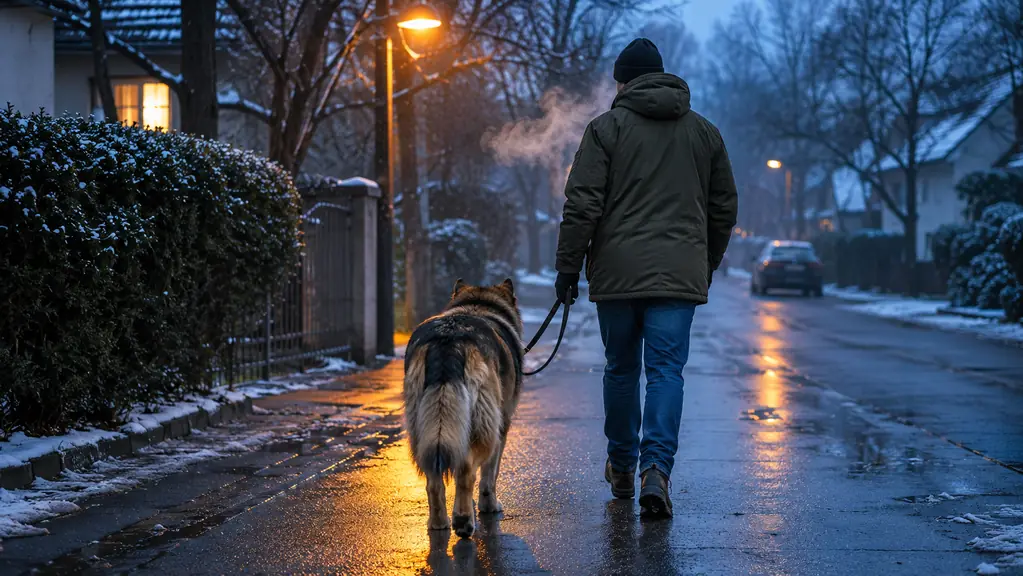
From November through February, our first walk happens before the sun does. The reflective strips on this harness catch headlights from a good distance, which matters on the two corners where there is no sidewalk. I still wear a small light on my jacket, but the strips are what a driver sees first, because they sit low and catch the beam at an angle. It is a small feature that turns out to matter every single winter.
One buckle and you are out the door
Murphy sits at the door and waits, mostly because he knows the routine. One buckle to fasten and we are walking. There is no wrestling match, no holding a squirming dog steady while I fumble with hardware in the dark. The buckle clicks hard enough that I can hear it over traffic, and in fourteen months it has never once come undone on its own. I check it anyway, because I check everything.
The stitching held, and I checked
I sew quilts, so I look at seams the way some people look at a used car. The webbing is bound at the edges, the stitching runs straight and even, and the chest strap edges have not frayed. After roughly eight hundred walks, the only wear I can point to is the colour, which has gone soft from sun and weather. Nothing has popped, split or pulled loose. If the construction had been sloppy I would have told you, because I have returned plenty of soft goods for exactly that.
It stays fitted when Dale takes the leash
My husband Dale walks Murphy on Saturday mornings so I can finish a quilt block in peace. Because the fit is set with the straps and stays there, Dale clips on without adjusting anything and the harness sits the same on the dog. That sounds like a small thing. It is not. The old collar setup meant Dale held the leash looser, Murphy pulled harder, and I heard about it for the rest of the day. Now the walk is uneventful, which is the highest compliment I can give a piece of gear.
What I'd Skip
Three things I would skip if I were starting over. First, skip the retractable leash with this harness. A retractable keeps constant tension on the line, which fights the whole point of a front clip, and you will spend the walk being towed by a spring. Second, skip sizing up for growth. Murphy was six when we bought this and the large fits him with room to spare. An adult dog is not going to grow into anything. Third, skip the back clip on day one if your dog is a hard puller. Start on the chest loop for a week, then decide. And do not tighten every strap just because it feels secure. You want to be able to slide two fingers under each one.
Fourteen months, roughly eight hundred walks, and the edges of the chest strap are still the edges that came out of the box.
Fourteen months, the same dog, the same two miles, the same harness
If your walk currently involves leaning back and hoping, the front chest clip is the part worth trying. Measure your dog's chest and read the size chart before you order.
Amazon Check Today's Price on Amazon →