
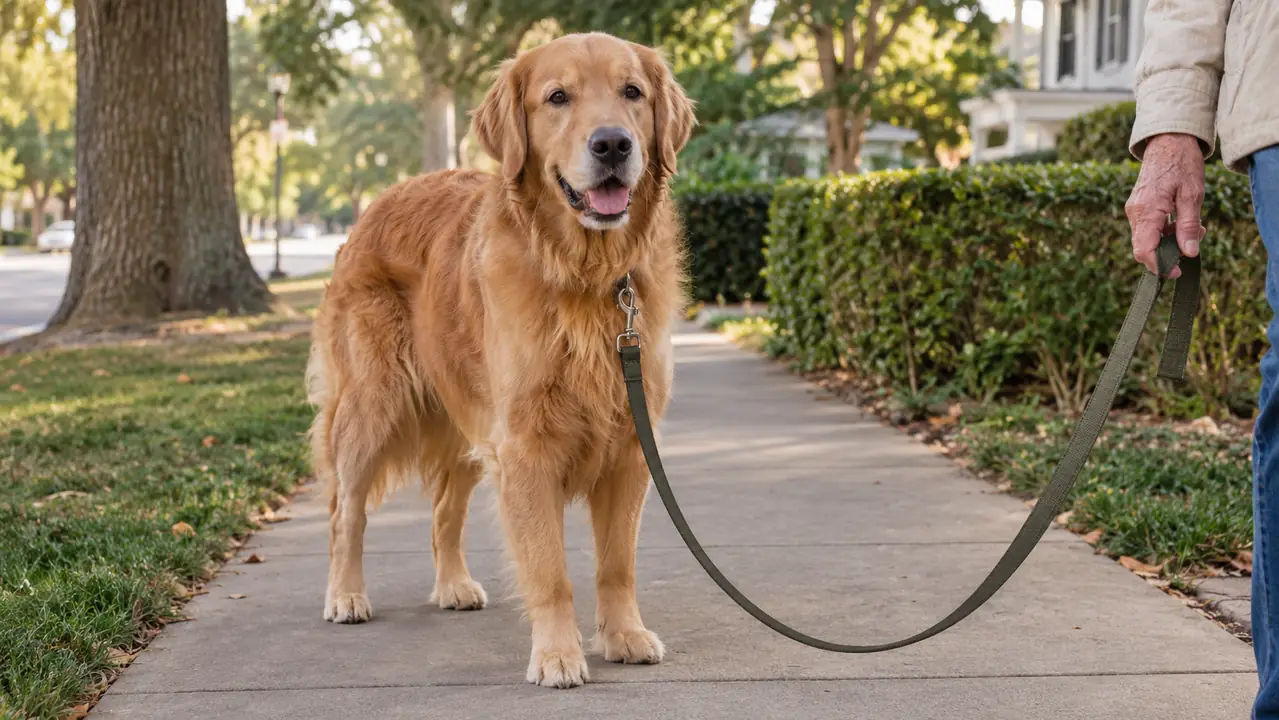
Murphy came home from the county shelter at two years old and has spent the four years since trying to reach the far end of every leash I own. Squirrels, mostly. Sometimes a leaf that moved wrong. By the time he was five I had stopped walking him around the block on icy mornings, because he had already pulled me off my feet once on the sidewalk and I did not want to learn what the second time would cost. What changed things was not a training book or a new attitude on my part. It was a rabbitgoo no-pull harness, a front-clip walk, and about six weeks of being extremely boring on the sidewalk.
I am not a trainer. I am a retired school librarian outside Knoxville who quilts in the evenings, so I notice stitching on anything made of fabric, and I notice when it starts to go. Take this for what it is: fourteen months of twice-daily walks with a strong 72 pound dog, about two miles a day, one rabbitgoo harness, still the original. Before it I used a flat nylon collar and a lot of apologizing to neighbors. This is the sequence I would follow again, in this order.
The front clip is the whole point. Here is the harness that has held up through 14 months of daily walks.
rabbitgoo No-Pull Dog Harness, size Large, chest 17 to 33.4 inches. Two metal leash loops, four adjustable straps, reflective strips, breathable mesh. The same harness Murphy still wears twice a day.
Amazon Check Today's Price on Amazon →Step 1: Measure the Chest Before You Pick a Size
Start with a soft tape measure and a dog standing still, which is a project of its own. Run the tape around the widest part of the ribcage, just behind the front legs, and write the number down. Murphy measured 31 inches, which put him comfortably inside the Large. rabbitgoo lists a 17 to 33.4 inch chest range for the Large and a 15 to 45 kg weight range, and that spread is wide enough that the chest number matters more than the weight. A 70 pound dog with a deep chest and a 70 pound dog with a narrow one do not take the same size.
The measurement people skip is the neck. If the neck opening is tight, the dog fights the harness going over his head, and then you decide the harness is the problem when the fit is the problem. The four adjustable straps exist to fix that, but they only fix it within the size you bought. They cannot add width that is not there.
If Murphy had landed between two sizes I would have gone up. A harness with a little room can be adjusted down. One that is snug at the chest cannot be adjusted up, and a snug chest strap on a pulling dog is exactly the thing that makes him pull harder, because now he has something to lean against.
One more note on size. If you have a young dog who is still filling out, the straps give you room to grow, but that room lives inside a size, not across sizes. Murphy was full grown at six, so I bought once and stopped thinking about it. A dog still adding weight wants a re-measure every couple of months, and probably a new harness somewhere around the eighteen month mark.
Step 2: Set All Four Straps, Then Check Them Again
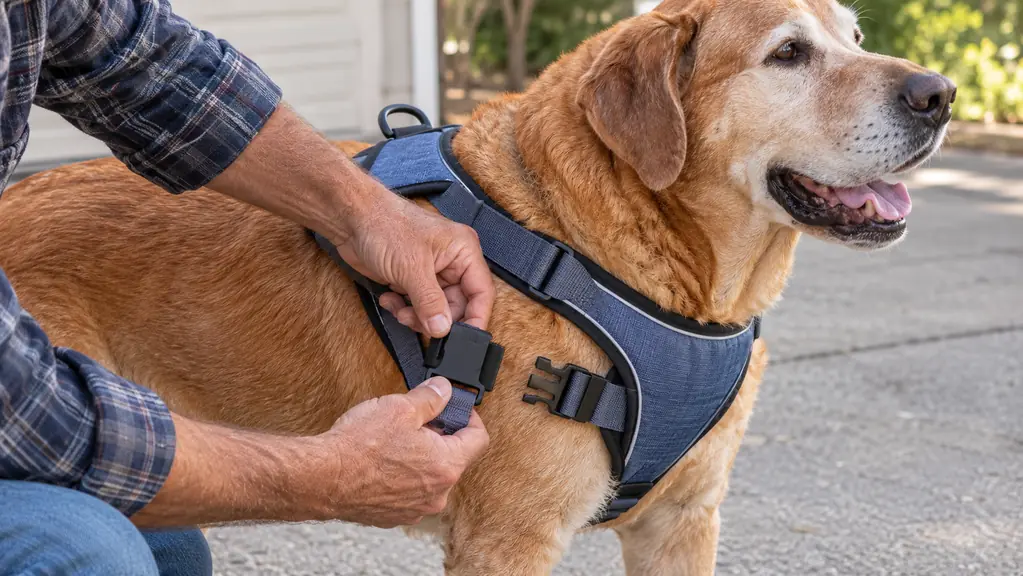
Loosen everything before the first fitting. Two straps sit at the neck and two at the chest. The harness goes over the head and the side buckle closes to hold it. Nothing about it is complicated, which is the reason it is easy to do badly in a hurry.
The first fitting is a two-person job in my house, mostly because Dale has steadier hands than mine. Do it in the house with the door shut and nothing else going on. Slip it over the head, close the buckle, give the dog a piece of chicken, take it off. Three evenings of that and Murphy started lowering his head into it on his own. He was not taught that. He decided it, which is the best kind of training there is.
Tighten until you can slide two fingers flat under each strap and no more. Check the chest straps with the dog standing square, then check them again after he has walked twenty feet, because the webbing settles once it is under load. On Murphy the neck straps needed an extra inch of slack past my first guess. The chest straps needed less.
Then watch the shoulders. If the front strap creeps forward onto the point of the shoulder, it will rub a bare patch in a week. If it slides back toward the armpit, the front clip will drag the whole harness sideways every time you use it. The right spot is between those two, and on a deep-chested dog it takes two or three walks to find. Once you find it, keep a record of where the straps sat. I put a dab of thread on mine, which is a quilter's habit and probably unnecessary for anyone else.
Step 3: Clip the Leash to the Front Chest Ring
This harness has two metal hook loops, one on the chest and one across the back. The back one is what people reach for, because it looks like where a leash is supposed to go. Reach past it. Use the front one.
A leash on the chest turns a pull into a sidestep. Murphy leans into a back clip and simply drags. With the front clip, the moment he commits his weight forward, the harness turns his front end back toward me and the forward pull stops paying him. Nothing dramatic happens. He just cannot get his shoulder into it, and a dog who cannot get his shoulder into it is not really pulling anymore.
The back clip still earns its place. I use it for sniff walks on the greenway, where I want Murphy to have the full six feet and I am not asking for a loose leash for twenty minutes straight. Two loops, two jobs. That is what the second one is for, and knowing which is which keeps the front clip feeling like a signal rather than a fight.
One habit worth building: hold the leash in your right hand with a loop of slack across your body and keep your left hand free. When the dog hits the end, that slack lets you absorb it instead of being jerked, and it keeps the front clip pulling at the angle it was designed for. If you wrap the leash around your wrist, you lose all of the give and some of the feeling in your fingers.
The harness did not teach Murphy anything. It bought me the two seconds I needed to teach him something myself.
Step 4: Stop Dead the Moment the Leash Goes Tight
This is the part that does the actual work, and it is the part nobody wants to hear. The harness buys you a pause. What you do with the pause is the training.
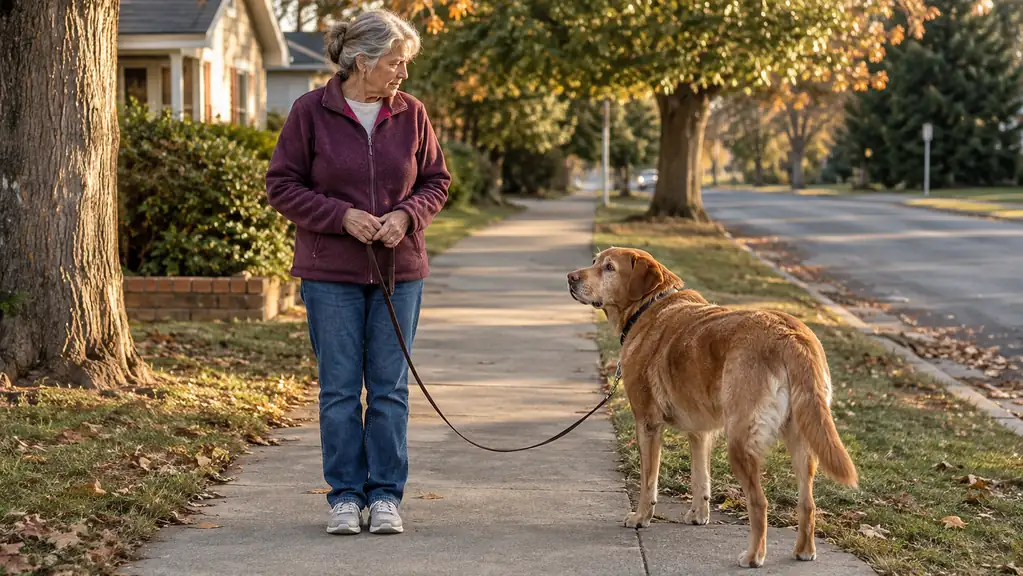
The rule I used was simple. The moment the leash goes tight, I stop. Not pull back, not say anything, not nudge him along. Feet together, hands at my waist, wait. When Murphy turns to look at me, the leash goes slack on its own, and then I say yes and we move forward. The first week we covered a quarter mile in twenty minutes. I want to be honest about that, because it looks like nothing is happening and it feels like a waste of a good afternoon.
What made it bearable is that the harness was doing the holding. On the flat collar I used to get dragged down the block while I stood there being patient. On the front clip, Murphy hits the end and turns himself, and my only job is to not add noise to it. Dale timed us on the fourth day: eleven minutes to the corner and back, which was our old pace, and the leash hung loose for most of it.
The whole thing falls apart if one person stops and the other keeps walking. Dale takes Murphy on Saturday mornings and for the first month he let the pulling happen because he felt sorry for the dog. Murphy worked that out in about two walks, because dogs always do. We had a short conversation at the kitchen table and after that the rules were the rules. Stopping is not unkind. It is the only way the dog learns which behavior gets him where he wants to go.
Step 5: Add Distance and Distraction Slowly
Once the sidewalk in front of the house is boring, add distance. Then add a distraction that is not a squirrel. Then, eventually, add the squirrel. Not all at once. If the leash goes tight and stays tight for more than a few seconds, you moved too fast, and the fix is to drop back to the easier version for a few days.
I carry a pocket of small treats and pay for check-ins, not for heel position. Murphy is a Lab mix. He is never going to walk like a show dog and I do not especially want him to. What I want is a loose leash and a dog who can look at a squirrel and then look back at me. Those are the two things I pay for and the two things I praise.
Fourteen months in, the harness is faded across the chest and the mesh is still intact. The reflective strips still catch headlights on our early winter walks, the buckle closes with the same click it always did, and the stitching at the front ring, which is where a quilter looks first, has not started to go. I have washed it twice by hand and let it dry flat on a towel, and it has held its shape both times.
The reason I started all of this was ice. Knoxville gets a handful of mornings a year when the sidewalk is a sheet, and a 72 pound dog who lunges on ice takes a 61 year old woman down. This past January we walked on three of those mornings and I never once felt the pull come through my shoulder. That is the entire return on the effort, and it is enough for me.
What Else Helps
A six foot flat leash, not a retractable. A retractable teaches a dog that pulling pays out more leash, which is the exact lesson you are spending six weeks trying to unteach. This matters more than the harness you choose.
Keep the harness on for the whole walk, including the sniff stops. Taking it off mid-walk and clipping to the collar teaches the dog that the rules change halfway through, and he will spend the second half testing for the change.
Trim the nails. A dog with long nails rocks back onto his pads, and that changes how he stands and how he leans. Murphy gets his done every six weeks and it is the cheapest item on this list by a wide margin.
Walk him tired sometimes. A dog who has had a real run in the fenced backyard is a different animal on a leash than one who has been inside all day. We do a hard fetch session before the evening walk and it does more for leash manners than any piece of gear I have bought.
And on the collar: Murphy still wears a flat collar with his tags on it, but I do not walk him on it. That is not a knock on collars, which are fine for a dog who does not lunge. It is that on a strong dog, a collar puts the whole correction at the throat, and the rabbitgoo spreads it across the chest instead. The breathable mesh panels under the straps mattered more in a Tennessee July than I expected them to, and the four adjustment points are what let a 72 pound dog with a deep chest wear the same Large as a narrower dog his weight.
Fourteen months, one harness, and a dog I can walk on an icy sidewalk again
rabbitgoo No-Pull Dog Harness, Large, chest 17 to 33.4 inches. Front clip for the walks that matter, back clip for the slow ones. Measure the chest first, then set all four straps with two fingers of room.
Amazon Check Today's Price on Amazon →