
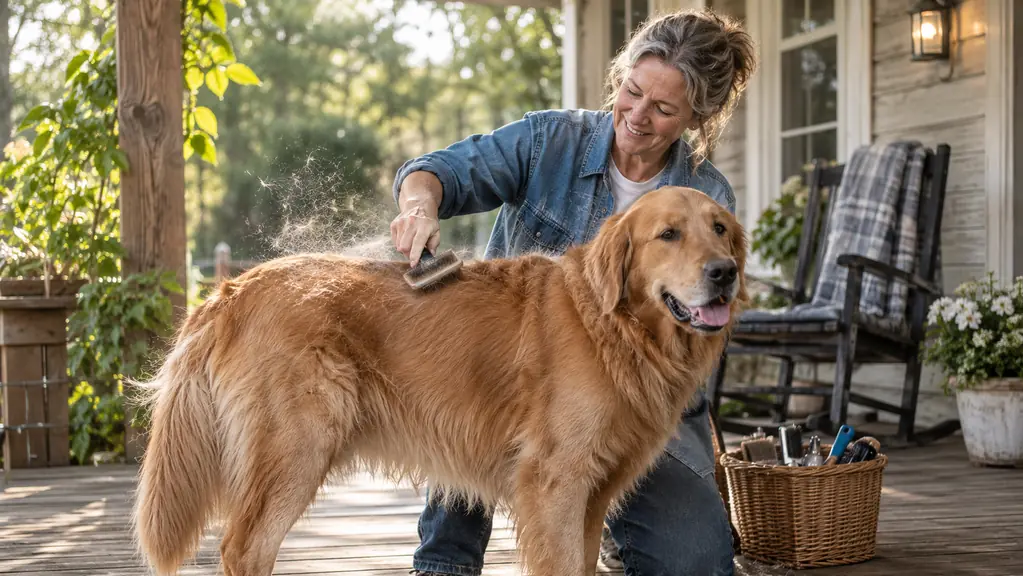
Murphy starts blowing coat the second week of March, give or take a warm spell, and then again in October. For about three weeks the house takes on a second layer of fur. It drifts under the chairs. It clings to the back of the couch where Dale sits. It finds its way into the quilt I have pinned out on the dining table, which is its own small crime in this house. I spent two shedding seasons with a cheap bristle brush before I admitted what was actually happening. That brush was smoothing the topcoat and leaving the undercoat exactly where it sat, packed against his skin, waiting for the first good shake.
A slicker brush does a different job. The fine wire pins get under the topcoat to the loose undercoat, lift it, and hold it in the head of the brush instead of letting it drift across the room. I bought the Depets self-cleaning slicker brush about a year ago and it has lived in the basket by the back door ever since. Two or three times a week in the quiet months. Daily in March and October. The pins are stainless steel, bent at 60 degrees, and there is a one-click release button that clears the head without me picking at it with my fingers. That button is the reason I still reach for it instead of the old brush.
The brush that gets under the topcoat instead of skating over it
Stainless steel pins bent at 60 degrees to reach the skin, plus a one-click release button that empties the head in one piece. Two or three minutes of clearing beats an hour of sweeping.
Amazon Check Today's Price on Amazon →Step 1: Start With a Dry Dog, Not a Freshly Bathed One
The order matters more than most people think. A bath first softens the undercoat and tightens it against the skin, and a slicker brush on a damp coat drags and pulls instead of gliding through. Brush first, bathe after, and the bath water stays a great deal cleaner because most of the loose hair is already in the bin. If Murphy comes in from the yard wet from rain, I towel him off and wait. Wet fur clumps, and clumped fur fights the pins.
The other half of step one is patience, and I am not naturally good at it. Murphy gets five minutes of nothing before the brush comes out. He sniffs the basket, he walks the fence line, he rolls on the same patch of grass he always rolls on. If I go at him the second he comes inside, he treats the brush as a thing to be dodged. If I let him settle first, he stands for it. Six years old and seventy-two pounds, and he still decides whether this is going to be an easy job.
Pick a spot and keep it. Ours is the porch on a dry day, or the kitchen floor by the back door when the weather is bad. Same place, same order, same basket. Dogs are great believers in routine. Murphy now lies down on the porch boards when he sees me carry the basket out, which is not enthusiasm exactly, but it is cooperation. The one time I tried brushing him out in the yard by the gate, he spent the whole session watching the road for the neighbor's truck and shifting his weight. We got through one side and gave up. The porch works because nothing interesting happens on the porch.
Step 2: Work in Sections the Width of Your Hand
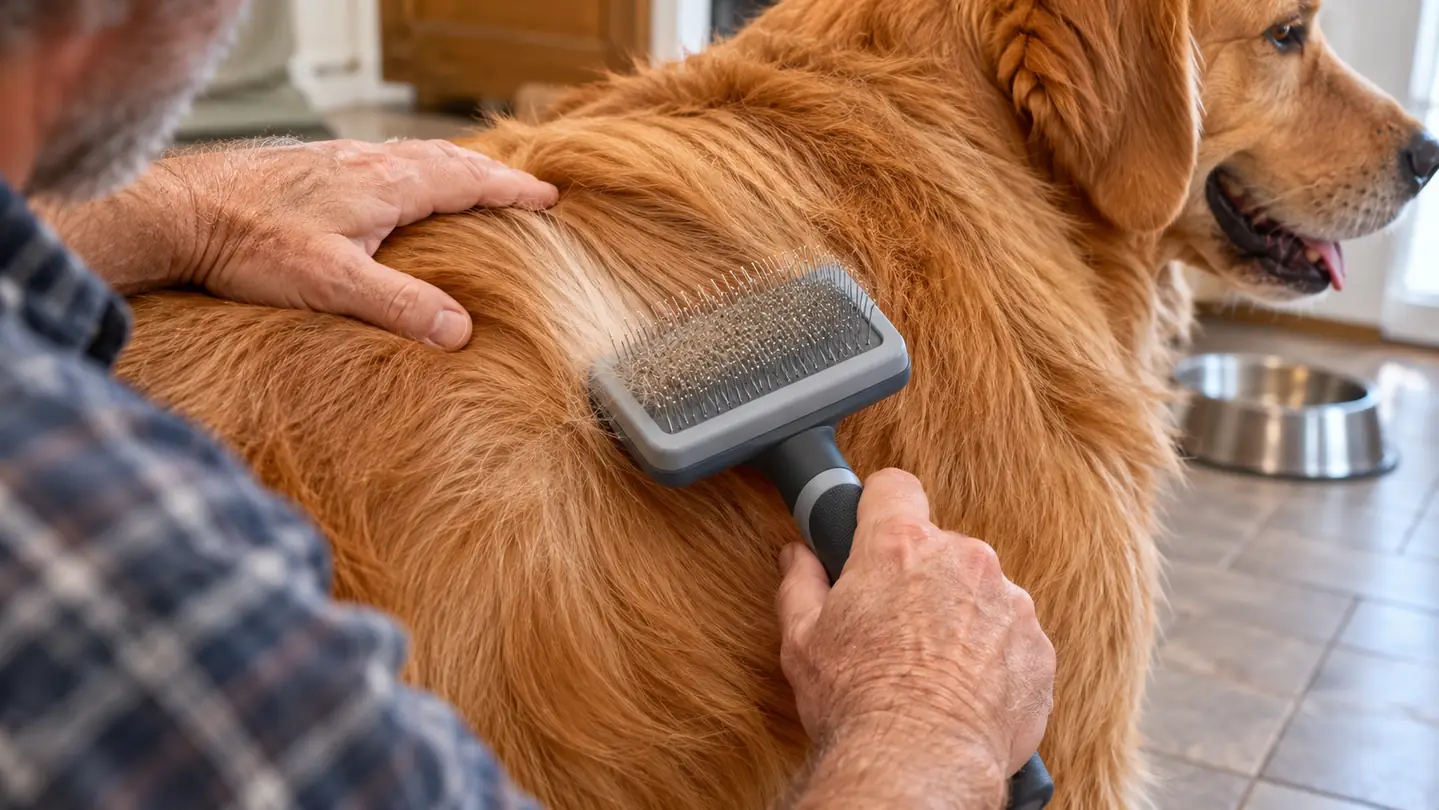
Big sweeping strokes feel productive and accomplish almost nothing. They skate along the top of the coat, which is already smooth, and never touch the layer that is actually shedding. Instead, lay your free hand flat on the dog's back and part the coat. Brush one section, roughly the width of your hand, then move over and take the next one. Slow is fine. Slow is better. I count the sections out loud sometimes, which sounds foolish and keeps me honest. Twenty sections down one side of a Labrador is a real number, and if I stop counting at twelve I know exactly where I left off when he wanders away and comes back.
Pressure is where people get it wrong in both directions. Too light and the pins never reach the skin. Too hard and you are raking a dog who did nothing to deserve it. The stainless pins on the Depets brush are bent at 60 degrees, and that bend is doing real work. It angles the tips so they slip under the coat and meet the skin at a shallow angle instead of poking straight down. Let the weight of your hand carry the brush. Your wrist steers. It does not push.
Watch the skin as you go. A little pink is normal on a dog who has been lying on a warm porch. Angry red, flaking, or a dog who flinches when you reach a particular spot is information. Stop there and look at it. If it does not look like ordinary dry skin, that is a question for the vet rather than a reason to brush harder. Same with mats. If you hit one behind an ear or under a leg, do not dig at it with the pins. Work at the outer edge with your fingers, or let a groomer take it.
Step 3: Line Brush, or You Are Only Petting the Dog
Line brushing is the whole technique, and it is not complicated. Lift a row of hair with your free hand and hold it up out of the way. Brush the strip of coat underneath that row, from the skin outward. Let the row down, take the next one behind it, and repeat. You are working through the coat in layers rather than over the top of it. It is the same idea as basting a quilt in sections instead of trying to run one long stitch across the whole thing. Small sections, one at a time, and the work actually holds.
The undercoat lives in specific places. On Murphy it is the rump, the back of the thighs, the chest, and either side of the spine. The legs and the face need a much lighter hand, and I keep the brush off his face entirely. A damp cloth does the muzzle and the ears. The pins are fine enough to do a good job on a flank and too much for skin that thin.
Where I notice the difference is the volume. Two or three rows down his side and the head of the brush is carrying a pad of undercoat the size of my palm. That is hair that was going to end up on the couch. Ten minutes of this in March does more than an hour of sweeping a bristle brush over the top. The rump takes longest. Murphy's back end is where the coat is thickest and where the loose hair packs down hardest, so I go over it twice and clear the head between passes. Under the tail and around the back of the thighs I use the corner of the brush head rather than the flat of it, which keeps the pins where I want them.
Two or three rows down his side and the head of the brush is carrying a pad of undercoat the size of my palm.
Step 4: Use the One-Click Button Before the Head Loads Up
A slicker brush stops working when the pins are full. The hair packs in, the tips stop reaching skin, and you end up polishing the topcoat again without noticing. The Depets brush has a release button on the head. You push it and the hair comes away in one pad instead of you standing there picking at the pins with your fingers. It takes about two seconds, which is the reason I actually do it.
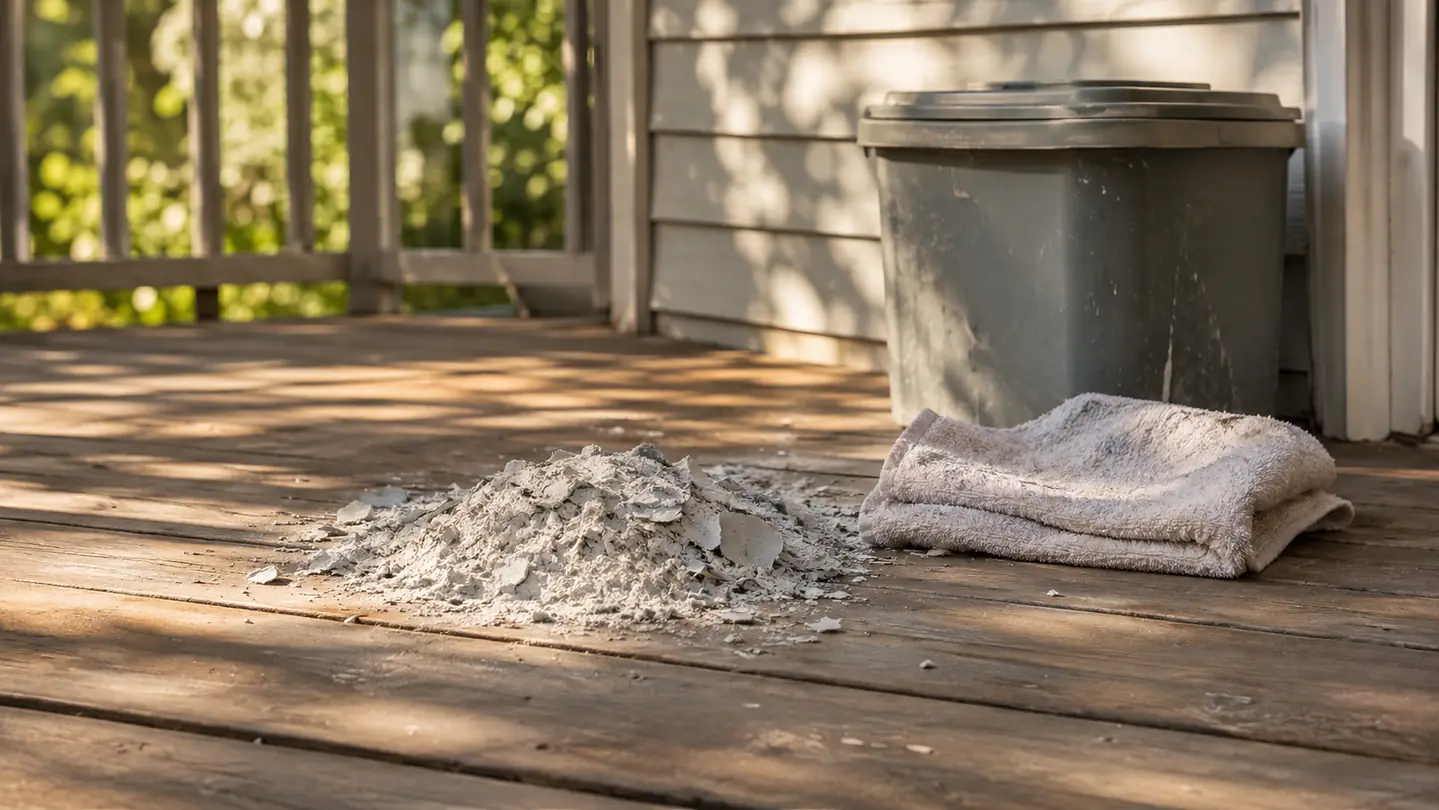
My rule is simple. Clear the head every few minutes, and always over something that catches the hair. I do it over the bin by the back door or straight off the edge of the porch. Clear it over the rug and you have simply moved the problem. When the pad comes off in one piece it also goes into the bin clean, instead of shedding a second time on the way there. I use a small lidded bin with a pedal, the kind meant for a bathroom, and it lives beside the back door from March to November. On the worst day last April I emptied it four times. That is not an exaggeration, it is what three weeks of a Labrador undercoat looks like when it comes off in pads.
The rest is ordinary care. It weighs about 100 grams, roughly 3.53 ounces, and measures 5.91 by 1.97 by 1.97 inches, so it sits in the hand without any heft and stows in the basket without claiming the whole thing. Wipe the head with a dry cloth now and then and keep it out of the water. It is a simple tool with no settings to learn, which at my age I count as a feature.
Step 5: Put It on the Calendar Instead of Your Mood
Shedding is seasonal and predictable, and brushing works best when it is predictable too. In the quiet months Murphy gets brushed two or three times a week, ten minutes at a stretch. In March and October it is daily, because the coat is coming out faster than any schedule can stay ahead of, and a missed day means a fresh layer on the floor. I write it on the calendar the same way I write the quilt guild meeting. If it is not written down, it does not happen. Dale marks the October start on the calendar too, mostly so he knows why the vacuum is out every evening and why he should not wear dark trousers to church.
Keep sessions short. A dog who is finished after eight minutes is finished, and pushing for another ten teaches him that the brush is something to avoid. End with a treat. Then check the skin once more in good light. If the coat looks patchy, if he is chewing at one spot, or if the shedding changes character entirely, that is a vet conversation and not something a brush can fix.
What Else Helps
A few small things make the job easier, and none of them cost much. A towel or a rubber mat under the dog keeps the hair in one place instead of distributing it across the floorboards. A lidded bin within reach means you clear the brush head without walking away, and walking away is how a brushing session turns into an unfinished one. I keep a lint roller by the door for my own trousers, because the hair does not care that I have finished.
For the worst week of the spring blow it helps to own a second tool. An undercoat rake gets deeper into the thickest part of the coat, and I use it on Murphy's rump before I finish with the Depets brush. A damp cloth handles the face and ears. A vacuum with a hose attachment handles the sofa, which Dale has learned to do without being asked twice. And if the shedding is new, sudden, or paired with itching or bare patches, book the vet before you buy another brush. No tool fixes a medical problem.
One more thing about timing, since it comes up. Brush before a bath, never after, and give the coat a day to settle before you decide the brush did nothing. The fur keeps working its way loose for a while. The quilt on my dining table is now covered with a sheet while I am binding it. That is not a grooming tip, but it is the truth.
Ten minutes, twice a week, and the fur ends up in the bin instead of the quilt
The Depets self-cleaning slicker brush: stainless steel pins bent at 60 degrees, a release button that empties the head in one piece, and 3.53 ounces of nothing to learn. It is the one I reach for in March.
Amazon Check Today's Price on Amazon →