
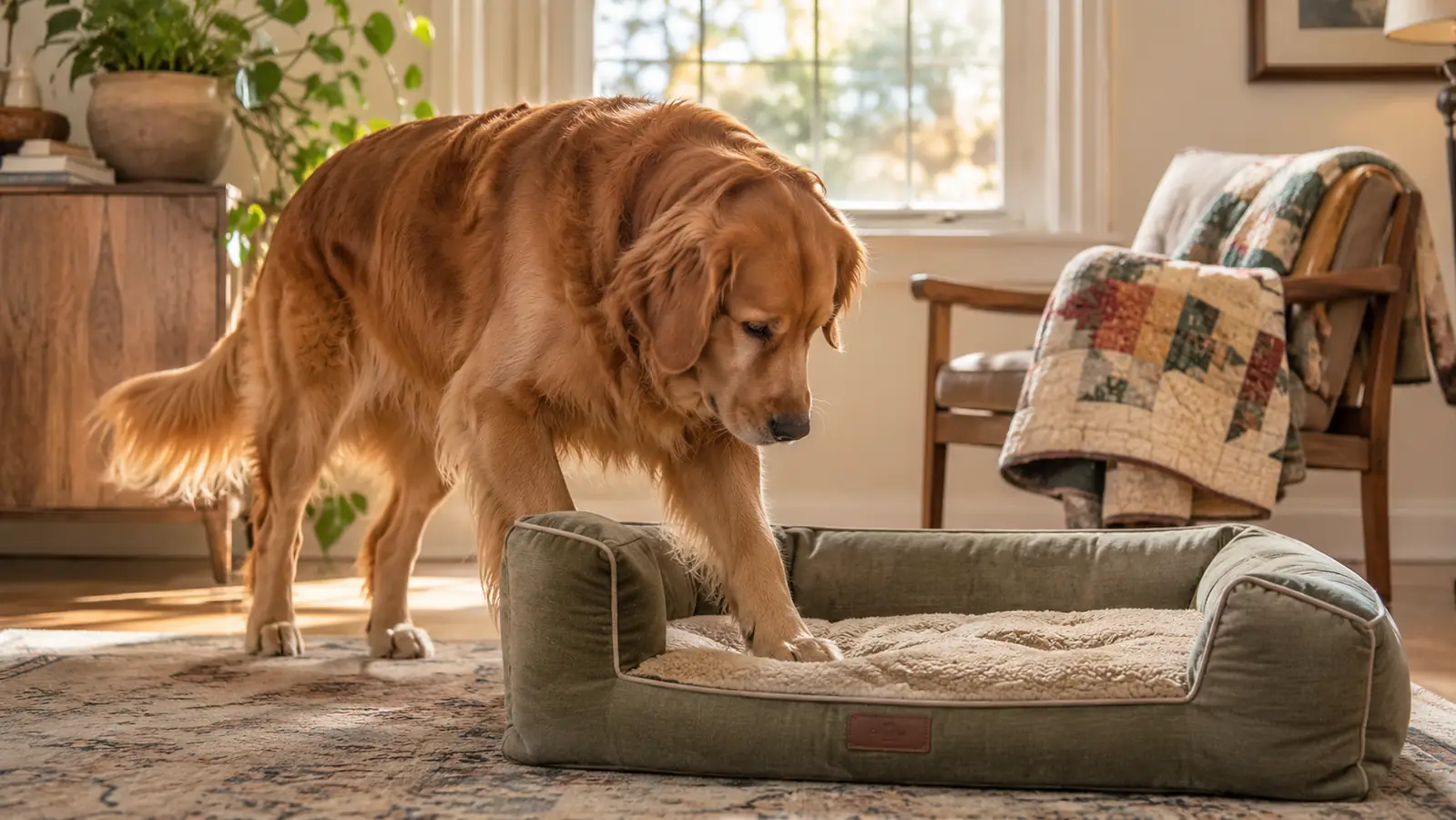
Most dog beds are sold by a word on the label. Large. Extra large. Giant. I have bought enough of them to know that the word means almost nothing. Murphy, our yellow Lab mix, is 6 years old and 72 pounds. He is not a giant dog, but he is not a lap dog either. Ten months ago, when he started to stiffen after long walks, I bought the Bedsure Orthopedic Dog Bed in the large size, 35 by 25 inches. I put it in the living room corner by the window. Before that he slept on a flat pillow-style bed from a big box store that went flat in a season. The Bedsure bed is still there. The difference was not the word large. It was the tape measure.
Here is the problem with sizing. A bed is a fabric object with seams and bolsters, not a cereal box. The outside measurement is not the sleeping area. A 4-sided bolster makes the bed feel secure, but it also takes up part of the footprint. If you buy by weight, you are guessing. If you buy by breed, you are guessing with more confidence. The only method that has worked for me is to measure the dog, measure the floor, and then read the spec sheet as carefully as I read a quilt pattern. This guide is the sequence I use now.
The Bedsure bed gives you a real number to work with
The large Bedsure Orthopedic Dog Bed is 35 inches long, 25 inches wide, and 7 inches tall. It has a 4-sided bolster, a removable cover, and a waterproof layer. Start there, then measure your dog.
Amazon Check the Bedsure Bed on Amazon →Step 1: Measure the dog, not the breed label
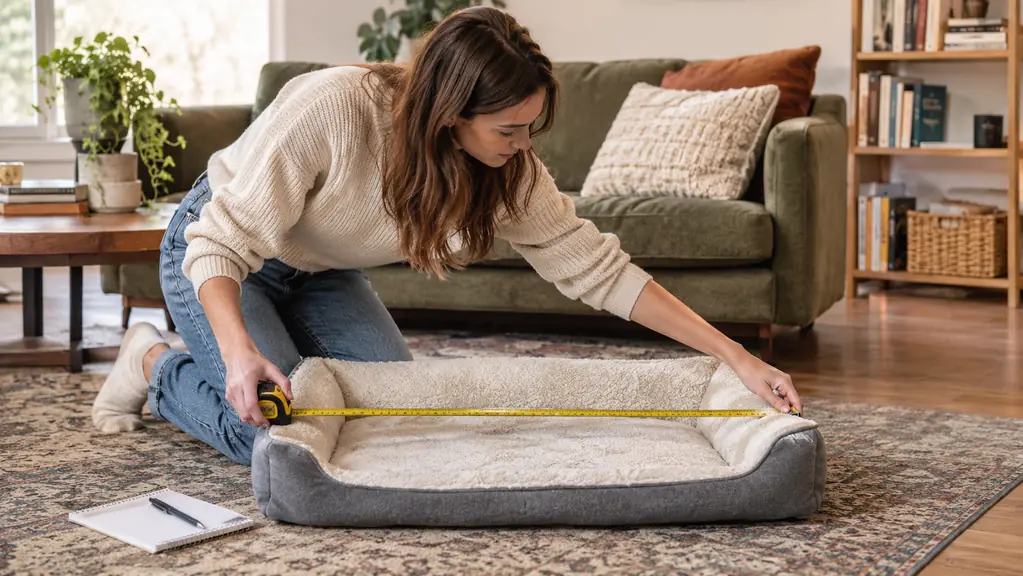
Use a soft tape measure and put it on the dog, not on the old bed. Run it from the tip of the nose to the base of the tail, where the tail meets the body. Then measure across the widest part of the shoulders. Write both numbers down. If your dog sprawls out flat when he sleeps, add 6 to 8 inches to the length. If he curls into a ball, you can use the body length as a starting point. Weight is a poor shortcut. Murphy is 72 pounds. A 72-pound greyhound and a 72-pound Lab mix do not take up the same floor space. The greyhound is longer and narrower. Murphy is deeper through the chest and curls into a comma. The Bedsure bed is 35 inches long and 25 inches wide. That gives you a rectangle to compare against your dog's rectangle, not a vague sense of large.
I also measure the sleeping surface, not just the outside. Set the bed on the floor and put your hand where the dog will actually lie. The bolsters on the Bedsure bed run around all four sides, so the usable middle is smaller than the 35 by 25 outline. For a dog that curls, that is fine. For a dog that stretches out flat, it can be tight. I learned this with the old pillow bed. It was labeled large, and Murphy hung off the end. The label was not a lie. It was a different definition of large.
The last part of measuring is the dog's age and joints. Murphy is 6, not a puppy, and he has started to stiffen after long walks. A bed that is too tall can be a hurdle. The Bedsure bed is 7 inches tall overall. That is low enough for Murphy to step into without a running start, but high enough that he can rest his chin on the bolster. If your dog is 12 or has trouble with stairs, put the bed on a non-slip rug and check the step height before you buy. A bed that is hard to get into is a bed that gets ignored.
Step 2: Match your dog's sleep style to the bed shape
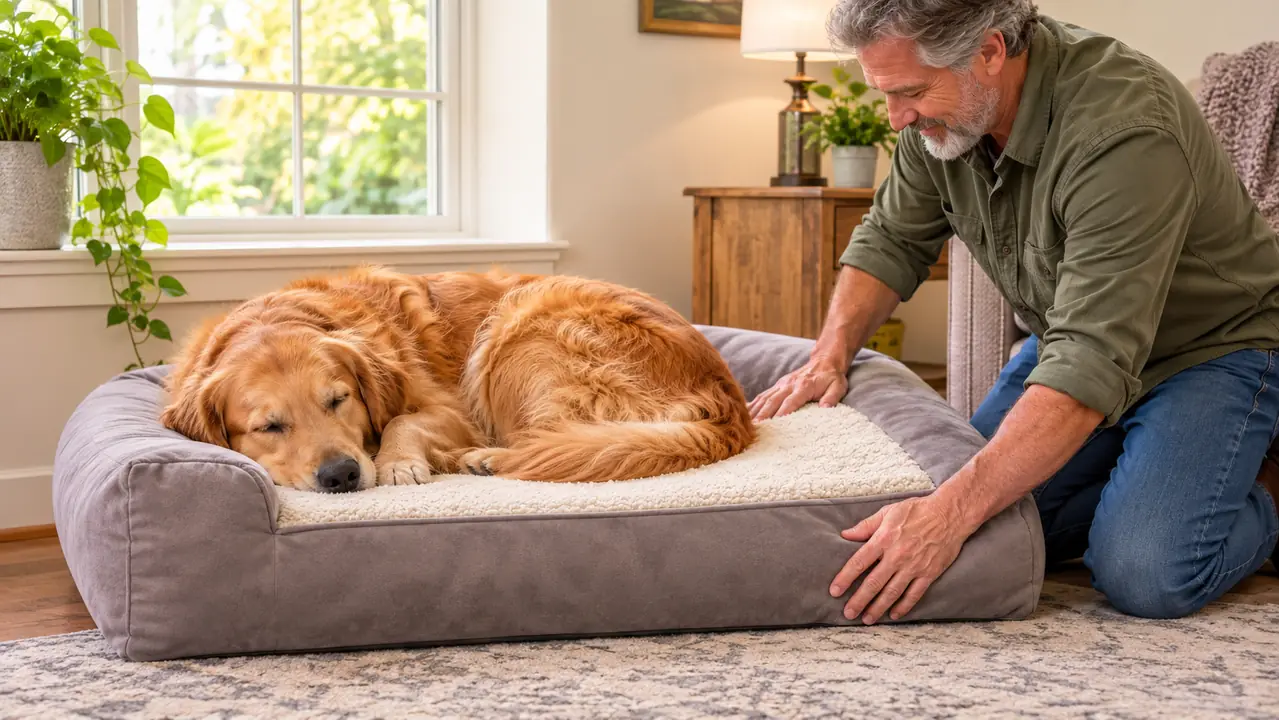
Watch your dog for three nights. Not the way you watch television, but the way you watch a quilt for a dropped stitch. Murphy sleeps in two positions. He curls into a tight comma with his nose tucked under his tail, and he stretches out on his side with one leg off the edge. The curled position wants a bolster. The stretched position wants length. A rectangular bed with a 4-sided bolster, like the Bedsure, is a compromise that leans toward the curler. If your dog is a committed sprawler, measure the longest stretch and add 6 inches. If your dog is a curler, the bolster matters more than the extra length.
Bolsters are not decoration. They give a dog something to press against, and that pressure is why some dogs sleep better in a bolstered bed than on a flat mat. The Bedsure bed has bolsters on all four sides, so Murphy can tuck his back against one and his nose against another. The tradeoff is that bolsters eat floor space and make the middle smaller. A flat bed gives you more usable area for the same outside dimensions. That is why I do not think a bolster bed is automatically better. It depends on the dog. A dog that flops on his side like a bear rug will not use the bolster. A dog that likes to be cupped will.
The shape also matters for how the bed sits in the room. A rectangular bed fits a corner better than a round one. The Bedsure bed is rectangular, 35 by 25, so it tucks into the living room corner by the window without blocking the path to the kitchen. Murphy can keep an eye on the driveway and still be in the room with us. A round bed would have left a crescent of dead space. That is not a reason to buy it by itself, but it is a reason to measure the corner as well as the dog.
Step 3: Read the spec sheet like a quilter
I sew quilts, so I read a spec sheet the way I read a pattern. First the dimensions, then the materials, then the care. The Bedsure Orthopedic Dog Bed is 35 by 25 inches with a 7-inch height, and it weighs 5.34 pounds. That weight matters. A large bed that weighs 5.34 pounds is easy to drag to the washing machine and easy to move when I vacuum. It is not a bed that will stay put if a dog launches onto it, but Murphy is past the launching stage. The cover is removable, and the listing says the bed is waterproof and easy to clean. I have washed the cover roughly every two weeks for ten months.
The foam is listed as CertiPUR-US certified, and the bed is Standard 100 by OEKO-TEX certified. I care about that more than I used to. A dog bed is a soft object that sits on the floor and gets slept on every day. I do not want a strong chemical smell in the living room. The Bedsure bed did not have one. The listing also says the maximum weight recommendation is 30 pounds. Murphy is 72 pounds. I am not going to pretend that number is not there. It is. He still sleeps on the bed, but he curls rather than stretches out, and I would not buy it for a 90-pound dog that likes to sprawl. The dimension is the more useful number. The weight recommendation is a flag to ask questions.
The details I look at as a quilter are the seams and the cover. The Bedsure cover has straight seams, and after ten months and a lot of washing it has not come apart. The bolster has kept its shape. That is not the same as saying it will last forever. It is a soft bed, not a piece of furniture. But it has held up better than the flat pillow bed that went flat in a season. If you are comparing beds, run your hand along the seam and look at how the cover is made. A cheap cover is the first thing to fail.
The Bedsure bed is 35 inches long and 25 inches wide. Murphy is 72 pounds. The tape measure told me more than the word large ever did.
Step 4: Fit the bed to your floor and your routine
A bed that is the right size for the dog can still be the wrong size for the house. Measure the spot where the bed will live. The Bedsure bed is 35 by 25 inches, so it needs a clear rectangle that size, plus a little room to walk around it. Murphy's bed sits by the window in the living room. It is out of the traffic path but close enough that he does not feel exiled. If I had put it in the back bedroom, he would have slept on the floor next to us instead. Dogs want to be where the people are.
Think about the floor surface too. A 5.34-pound bed will slide on hardwood. I put a thin rug under the Bedsure bed so it does not skate when Murphy steps in. On carpet, that is less of an issue. If you have a dog that circles before lying down, give the bed a little extra room. Murphy circles twice and then drops. The first week, he stepped on the edge and the bed shifted. The rug fixed that. These are small things, but they decide whether a bed gets used or becomes another object to step over. The last fit question is the dog's routine. Murphy sleeps in the living room during the day and in our bedroom at night. I did not buy two Bedsure beds. I bought one and put it where he spends the most time.
If your dog sleeps in a crate at night, measure the crate, not the room. A 35 by 25 bed may not fit a crate that is labeled large. Take the crate mat out and measure it. The bed has to fit inside the crate without blocking the door. That is a different measurement from the floor. I have not tried the Bedsure bed in a crate, because Murphy does not use one at night, but the same rectangle rule applies. Measure the opening, then the mat, then the bed.
Step 5: Test the wash routine and the dog before you commit
A dog bed is a fabric object in a house with a shedding dog. Murphy sheds heavily twice a year. The Bedsure cover comes off and goes in the washing machine. I have washed it roughly every two weeks for ten months. That is the real test. If a cover cannot be washed, the bed is a disposable item. Check your machine. A 35 by 25 cover is not huge, but a bulky bolster can fill a drum. I wash it on a gentle cycle and line dry it. The waterproof layer is the reason I am comfortable with this bed on a wood floor.
Before you cut the tags, read the care label and the return policy. I know that sounds like advice from a librarian, but I am a retired school librarian, so that is the voice you are getting. Wash the cover once before the dog uses it if you are sensitive to smells. Check the seams at the corners, where a dog's weight pulls the most. The Bedsure bed passed that first wash. The second wash is the one that tells you whether the cover will hold up. Ten months in, it is still going. The other test is the dog. Put the bed down and leave it alone. Do not coax. Murphy ignored the Bedsure bed for two days and then slept on it for a week straight. If your dog will not use it after a week, the size or the shape is wrong. A bed that is too small gets circled and abandoned. A bed that is too big can feel exposed. The right size is the one your dog chooses.
What Else Helps
A bed is one part of a comfort setup. Murphy also eats from elevated bowls, which took some strain off his neck, and he wears a no-pull harness on walks. Those are not bed decisions, but they are part of the same question: how do I keep an older dog comfortable? If your dog is stiff after walks, look at the floor. Hardwood is hard to get up from. A runner or a rug in the path between the bed and the door can help more than a thicker bed. I put a rug by the back door for that reason.
If you are between sizes, go by sleep style. A curler can use a smaller bed with a bolster. A sprawler needs length. A dog that likes to stretch out flat should get the longest bed that fits the room. A dog that tucks into a ball can use a bed that is closer to its body length. And if your dog is a puppy, do not buy the biggest bed you can find. Wait until the dog is full grown, then measure. Puppies grow into beds the way children grow into shoes, which is to say unevenly.
If the 35 by 25 footprint fits your corner, this is the bed I would start with
The Bedsure Orthopedic Dog Bed has a 4-sided bolster, a removable cover, a waterproof layer, and a 7-inch height. It has held up to ten months of washing in my house. Measure your dog and your floor first. Then decide.
Amazon See the Bedsure Orthopedic Dog Bed on Amazon →