Murphy is six years old, a yellow Lab mix, about 72 pounds, and for the first four years I fed him out of two stainless bowls on the kitchen tile. He would take a mouthful, lift his head, chew, look around the room, and take another. Twice a day, twenty minutes a meal. I assumed he was a slow eater with a short attention span. He was not. He was a dog holding his neck at an angle it did not want to hold for twenty minutes at a stretch.
About eight months ago I bought the COMESOON elevated dog bowls, the four-height stand with two stainless bowls, and I did what almost everybody does with a new feeder. I picked the setting that looked about right, filled the bowls, and set them down. It was better immediately, and that was the problem. It was good enough that I stopped paying attention, and it took three weeks before I noticed Murphy still stepping back from the bowl between bites. He was on the wrong height. The right one was two inches lower.
Four heights on one stand, so your dog can tell you which one is right
The COMESOON raised bowl stand adjusts to 3.7, 9.2, 10.75, and 12.36 inches, folds flat when you need the floor back, and comes with two 50 oz stainless bowls.
Amazon Check Today's Price on Amazon →What the Four Heights Are Actually For
Before you measure anything, it helps to know that the range on this stand is wider than most raised feeders offer, which is the main reason it worked for us. Four settings means it can follow a dog from puppyhood to old age instead of being replaced twice. Here is how I would read them if I were starting from scratch.
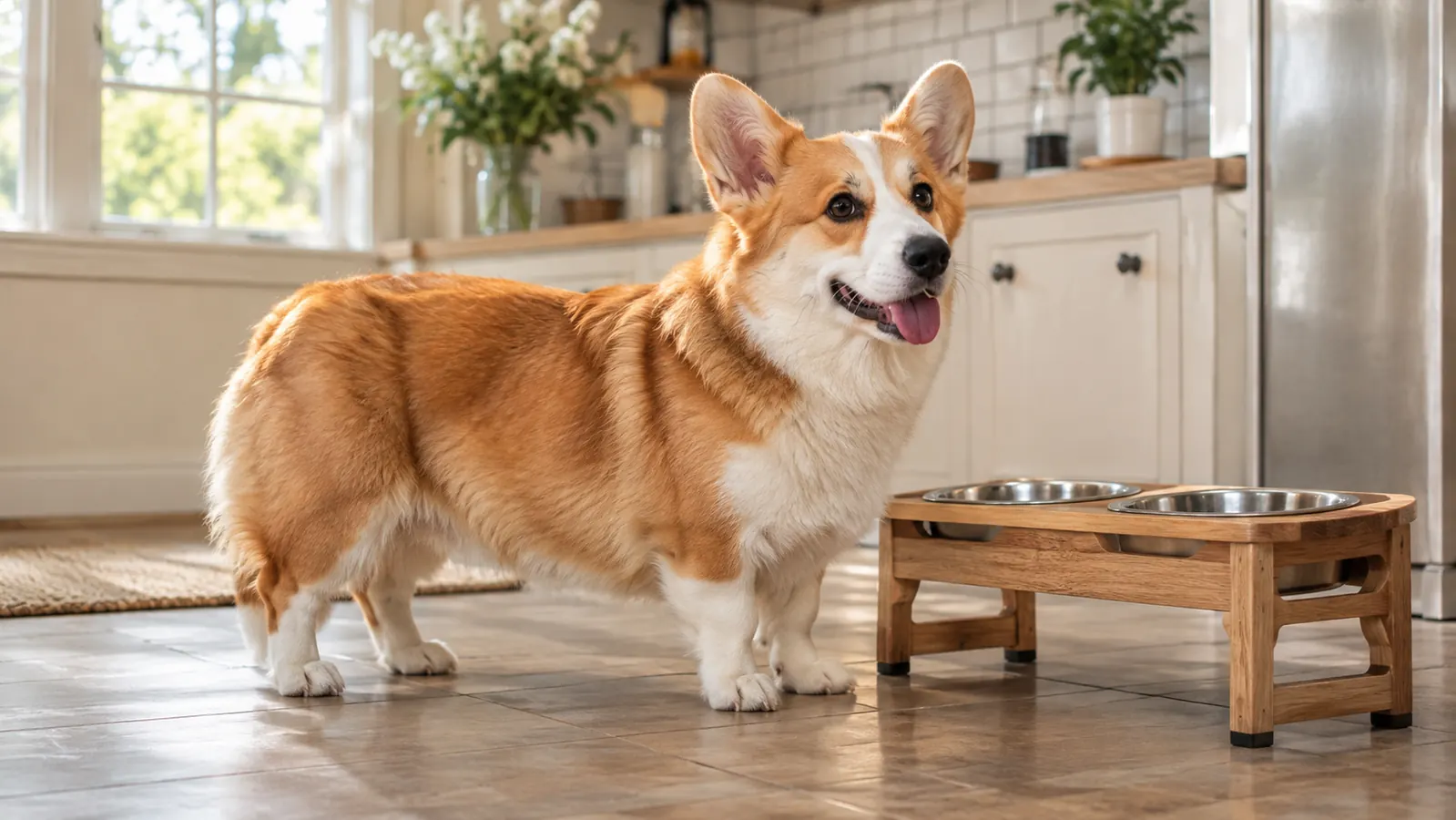
3.7 inches is a near-floor stand, for a small breed or a young puppy. It is also the setting for a dog recovering from a front-leg injury who should not be reaching down at all. 9.2 inches suits a medium dog, roughly 30 to 45 pounds, and it is where most beagle-sized and corgi-sized dogs end up. 10.75 inches is where the Labs, shepherds, and other 60 to 80 pound dogs tend to land. 12.36 inches is for genuinely tall dogs, the Danes and the big mastiffs, and for a Lab-sized dog it is almost always too high.
The catch is that weight is a poor proxy for height. Two dogs at 70 pounds can differ by three inches at the shoulder, and a deep-chested dog carries his front end differently than a stocky one. Treat the list above as an educated guess and then measure your own dog, which is the next step and the one that actually matters.
Step 1: Measure the Dog, Not the Bowl
You need two numbers, and neither one is the height of your current bowls. Measure from the floor to the top of the shoulder blades, the withers. Then measure from the floor to the lowest point of the ribcage, right behind the front legs. Murphy measures 23 inches at the withers and about 16 inches at the bottom of the chest.
Those two numbers bracket where the rim of the bowl should sit. Aim for the rim at or just below the bottom of the chest, never above it. Above the chest line, the dog has to lift his head to swallow, and a dog lifting his head to swallow is a dog who drops kibble on your floor and walks away from the bowl.
For Murphy that put the target somewhere between 10 and 12 inches, which meant only the top two settings on the COMESOON stand were ever in play. The 12.36 inch setting put the rim above his chest line and he had to crane upward. The 10.75 inch setting put the rim just below it and his neck stayed level from the first bite. The 9.2 inch setting was not far off, but he had to reach down further than he does on a walk, and he started planting a front paw beside the stand.
Step 2: Set the Stand Before the Dog Comes In
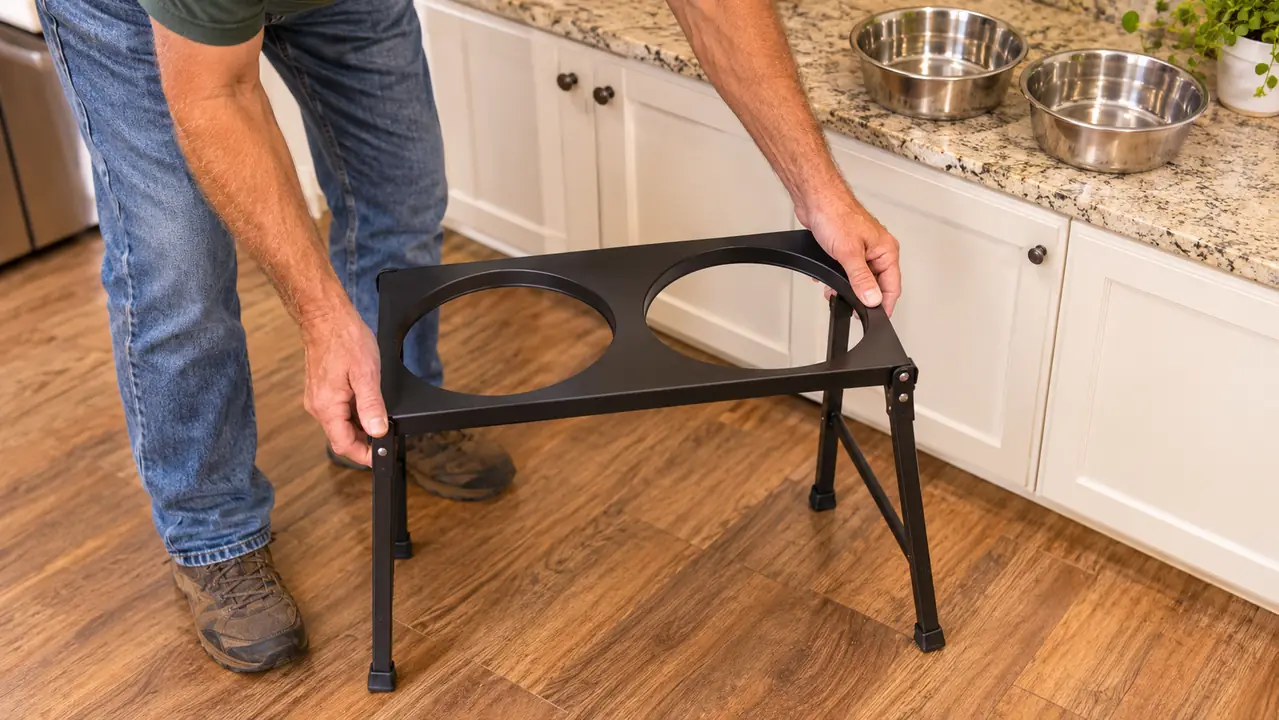
Set the stand up in the spot where it will live, on a flat floor, with the dog out of the room. It goes together without tools and the legs fold, which is why ours travels, but that also means it is worth thirty seconds of attention before there is food in it. Press down on the top of the frame with your palm. If anything shifts or rocks, something is not seated all the way and you should take it apart and start again.
The footprint is 16.8 by 10.1 inches, so give it a wall or a cabinet to sit against while leaving room for the dog to walk straight in from the front. A feeder wedged sideways against a cabinet door makes dogs approach at an angle, and an angled approach is how you get a dog eating with his body twisted. Ours is listed as non-slip and on our tile it stayed where I put it, though it stayed put best on a clean floor. Mine sat over a patch of dried kibble dust for a week before I noticed it had started to scoot.
Then seat both bowls. They are 50 oz each, which is generous for one dog, and they drop down into the frame. Push each one with a finger before you fill it. A bowl that rocks is a bowl that gets flipped by a dog licking the last of the water.
Step 3: Watch the Neck Line, Not the Tail
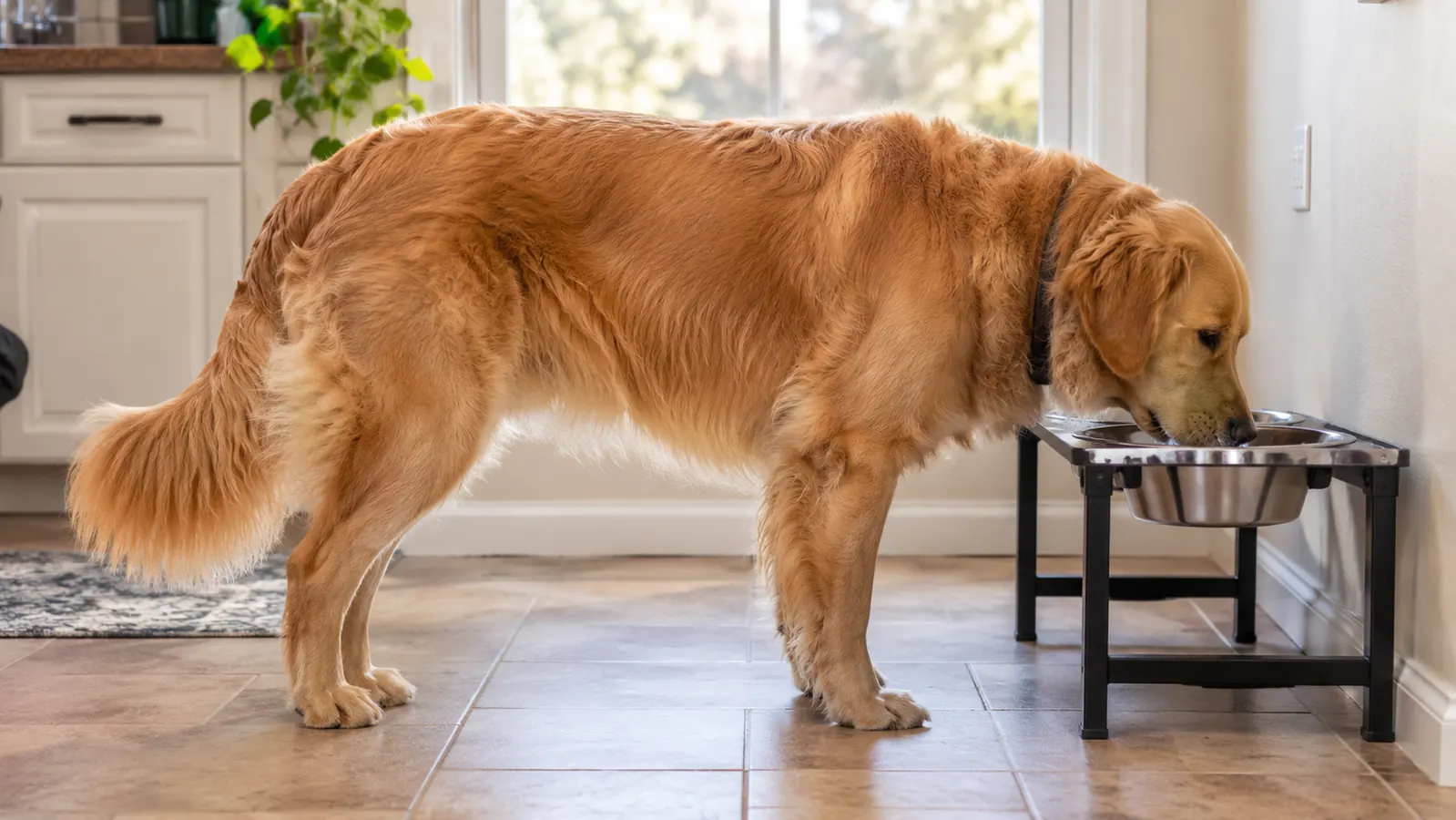
Put the dog at the stand with the bowls empty and look at him from the side. You want the front legs vertical under the shoulders, the topline roughly level, and the neck level or angled slightly down. That is the whole picture. If the neck is angled up, the stand is too tall. If he is reaching down with a hollow in his back, the stand is too short.
There are smaller tells. A dog on a stand that is too tall will step backward between bites and come at the bowl from the side. A dog on a stand that is too short will splay his front elbows and sometimes park a paw inside the footprint. Murphy did the backward step at 12.36 inches for two days before I moved it down, and it took one meal for the stepping to stop.
This is also the moment to be honest about your dog's shape. A deep-chested dog, a greyhound build or a big shepherd, carries more of his weight in front, and the right rim height for him is not the right height for a Lab of the same weight. Measure your own dog, twice, and write the numbers on a sticky note inside the cabinet door so you stop guessing.
At 10.75 inches his neck sat level for the first time. He stopped stepping back between bites, and the meal went from twenty minutes to nine. That was the whole test, and it took one evening.
Step 4: Run a Timed Meal, Then Leave It Alone
Fill the bowl to the level you normally would and time the meal with your phone. Not to make him faster, but because meal time is a decent proxy for comfort. A dog working at an awkward angle takes longer and quits sooner. Murphy's twenty minutes at floor level became nine at 10.75 inches, and he stopped leaving the last third of the bowl.
Then leave the height alone for a full week. This is the hardest part for me, because I like to fiddle. Whatever setting you land on, give the dog seven days of the same setup before you decide anything. Dogs adjust to a food station the way they adjust to a new chair in the living room, which means the first two meals tell you very little.
One caution, and it is not about this stand in particular. There has been a long-running argument among veterinarians about whether raised feeders raise the risk of bloat in deep-chested dogs, and the research is not tidy. If your dog is a deep-chested breed and a fast, gulping eater, have that conversation with your vet before you change anything about how he eats. A stand is a comfort tool, not a medical device, and it will not fix a dog who is inhaling his dinner.
Step 5: Re-Check the Height With the Seasons
An adjustable stand is only useful if you actually adjust it. Puppies need the bottom setting and will outgrow it in weeks. Older dogs lose height in the front end before they lose it anywhere else, and the height that was right at five years old can be an inch too tall at eight. That is the case with the four-height COMESOON stand: the settings are not a one-time decision, they are a thing you revisit.
Murphy started stiffening after long walks this past year, which is why the orthopedic bed is in the living room corner now. When he stiffens, he stands differently at the bowl, so I check him every few months. The check takes three seconds. Stand him at the feeder, look at the neck, look at the front legs. If the picture has changed, drop the stand a setting.
While you are down there, check the bowls and the frame. Stainless bowls get dropped and dented, and a dented bowl will not seat flat. Wash both bowls weekly at minimum, and more often in summer if you keep water in the second one.
What Else Helps
Height is most of the job, but not all of it. Put the stand where the dog can approach it dead on rather than from a corner, and keep it far enough from the wall that a wagging tail is not hitting drywall while he eats. Having both bowls in the stand is more useful than it sounds. Water at the same height as food means a dog who drinks without doing a split, and two 50 oz bowls hold more than enough for a 72-pound dog across a day.
Feed the same amount you always did. A raised bowl can make a dog eat faster, and faster is not automatically better for a big dog. If Murphy starts bolting, I spread his kibble across the bottom of the bowl instead of piling it. That slows him down without changing anything about the stand. Keep a towel nearby for the first week, too. A dog eating with a level neck still drops crumbs, just fewer of them and in a tighter pile.
The stand also travels, which I did not expect to care about. The legs fold, the bowls lift out, and the whole thing weighs 3.2 pounds, so it goes in the back of the Outback on lake weekends next to the hammock seat cover. Murphy eats at the same height at the cabin as he does at home, and over a summer that consistency turned out to be worth more than the packing space it costs.
Measure once, set the height, and stop thinking about it
The COMESOON raised feeder adjusts to 3.7, 9.2, 10.75, and 12.36 inches, comes with two 50 oz stainless bowls, and folds flat when you need the kitchen floor back.
Amazon Check Today's Price on Amazon →